

By Nishant Saxena & Mayuri Singh
As COP30 opens today in Belém, the world’s energy conversation feels more urgent and complex than ever. The summit is arriving at a decisive moment. Climate ambition is abundant, but delivery is lagging, and the gap between what’s promised and what’s happening on the ground keeps widening.
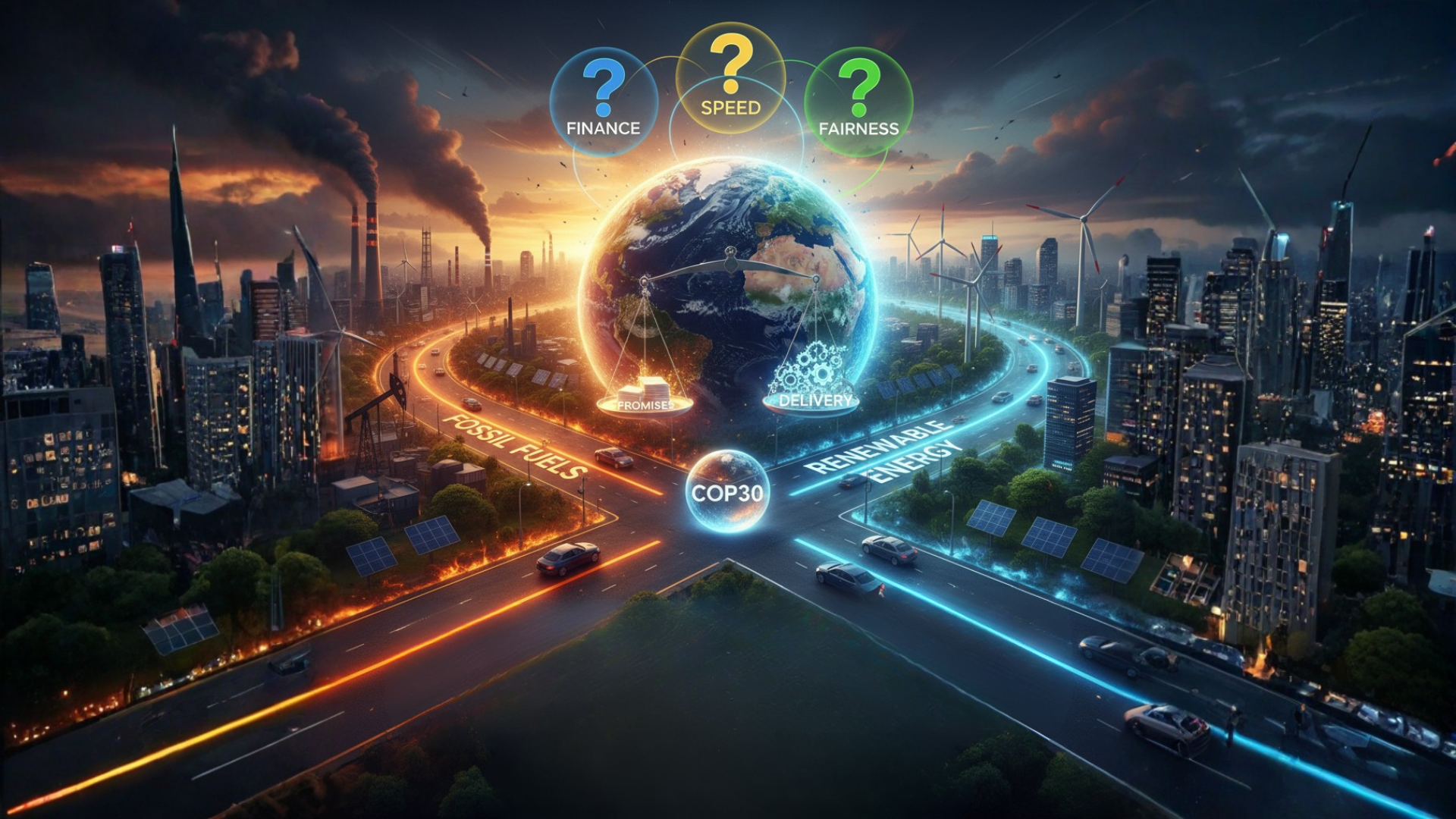
At the heart of COP30 lies a trinity of questions that define the future of global energy. How fast can the transition happen, how fair will it be, and who will finance it? These are not abstract questions, they shape every nation’s growth trajectory, every investor’s confidence, and every worker’s livelihood.
The Global Energy Pulse: Progress and Pressure
In 2024, the world added around 320 GW of new renewable capacity, mostly solar and wind, a healthy 15 per cent jump from 2023, but still far short of the 900 GW per year required to triple renewables by 2030. Renewables now supply about 29 per cent of global electricity, up from 26 percent in 2023. Yet coal and gas continue to dominate, contributing nearly 60 per cent of total power generation.
This imbalance underscores a deeper issue. Even as technology and economics favour renewables, the pace of policy alignment and financing lags behind. The much-discussed $100 billion annual climate finance goal remains unmet. On average, only $65-70 billion is flowing each year, and an even smaller share reaches developing nations in concessional or grant form. Without predictable funding, the transition risks stalling before it gains momentum.
The Equity Equation: India’s Balancing Act
India’s journey reflects both hope and hardship. The country’s renewable energy capacity surpassed 200 GW in 2025, crossing its initial 2030 milestone of achieving 50 per cent non-fossil installed capacity. In 2024 alone, India added roughly 35 GW, showing real intent. Yet the road ahead remains steep. Grid stability, storage solutions, and clean fuel integration continue to test both infrastructure and policy.
To meet its 2030 goals, India estimates a need for over $500 billion in clean energy investments. This makes accessible and concessional finance not just a demand, but a prerequisite for progress. India’s negotiating stance at COP30, rooted in the principle of Common but Differentiated Responsibilities, calls on historical polluters to do more, faster, and with fairer support to developing economies.
At the same time, India’s domestic narrative is evolving. Beyond megawatts and gigatons, it is about ensuring the transition uplifts people. Clean cooking, universal electricity, and reskilling workers for a green economy are core national priorities that echo COP30’s central theme: a just transition that leaves no one behind.
The Coal Question and the Just Transition Work Programme
Globally, coal-fired power capacity began declining after peaking in 2023. Countries like the UK, Canada, and South Africa have committed to no new unabated coal projects and are accelerating plant retirements. COP30 is expected to sharpen transparency around coal phase-down timelines and press for legally binding accountability.
The Just Transition Work Programme (JTWP), a major agenda item this year, is gaining traction as the human face of the energy transition. Its focus on social protection, workforce reskilling, and economic diversification aims to cushion coal-dependent regions from economic shocks. India too is aligning its domestic strategy with JTWP goals, expanding renewables and clean hydrogen while initiating reskilling programs for coal-sector workers to ensure that progress remains inclusive.
Regulation and Law: The Hidden Battlefield
As we often highlight, the success of this transition rests not just on ambition, but on legal and regulatory clarity. That’s where much of the real action, and friction, now lies.
Countries implementing carbon pricing mechanisms are grappling with the evolving rules of Article 6 of the Paris Agreement, which governs international carbon markets. India has begun pilot initiatives but awaits definitive frameworks to ensure market integrity and fairness.
Meanwhile, regulators are tightening disclosure norms. In India, SEBI’s enhanced ESG reporting requirements have raised the bar for corporate accountability, compelling companies to integrate climate risk into core governance. Across several economies, legal challenges against fossil fuel subsidy removals are testing the political and judicial will to prioritize long-term sustainability over short-term populism.
These developments reveal the twin complexity of the energy transition; it is as much a legal transformation as it is a technological one.
From Targets to Tangibility
COP30’s defining measure of success will be its ability to convert ambition into acceleration. The expected outcomes are clear but challenging:
- Deliver stronger national pledges to triple renewable energy capacity by 2030.
- Double global energy efficiency improvement rates to curb demand and emissions.
- Establish a credible framework for phasing down fossil fuels in a just and transparent manner.
- Operationalize the Just Transition Work Programme, turning policy into practical mechanisms.
- Mobilize predictable climate finance and rebuild trust between developed and developing nations.
- Promote country-led coordination platforms to speed up implementation across grids, storage, and technology transfer.
The Moment of Truth
In many ways, COP30 is not about new promises but overdue proof. The world has already set its compass; now it must start moving decisively in that direction.
For India and the broader developing world, the challenge is not lack of intent but lack of infrastructure, technology, and predictable finance. For developed nations, it is about credibility, honouring commitments made over a decade ago.
COP30, therefore, represents a pivotal moment in the global energy narrative. If the world can align speed with fairness and ambition with action, this could be the summit that transforms climate intent into measurable progress.
Because in the end, the question is no longer what should be done, but how much longer can we afford not to?
Also Read: When Electricity Policy Becomes UPSI: Inside SEBI’s IEX Case and CERC’s Parallel Probe
One response
[…] Also read: COP30 and the Energy Transition Crossroads: Can the World Turn Promises into Power? […]