

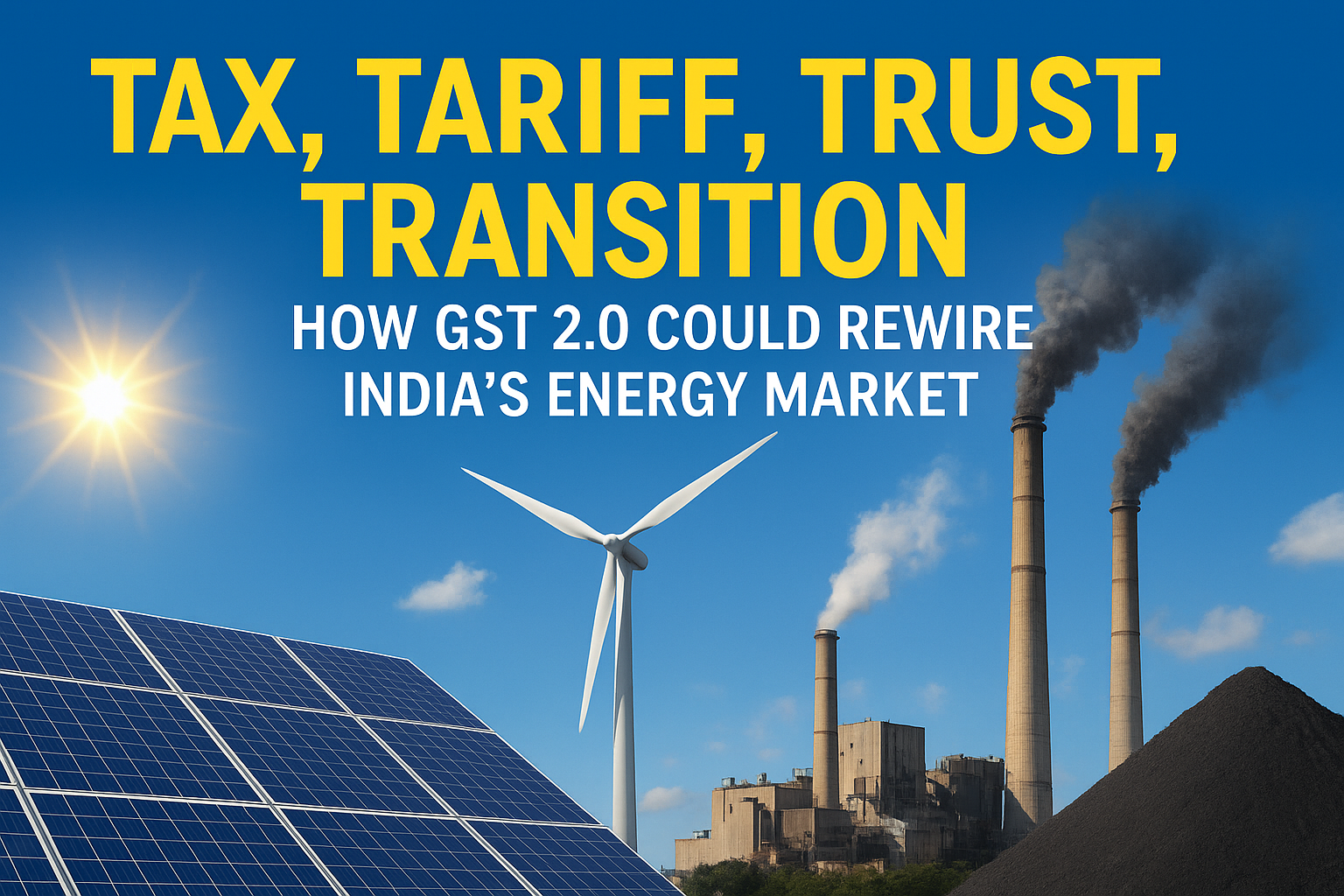
Sometimes a tax reform is more than a fiscal tweak. It can reset the economics of an entire sector. India’s latest GST changes do exactly that. By cutting GST on renewable components from 12% to 5% and raising coal GST from 5% to 18%, the government hasn’t just changed tax slabs, it has tilted the entire playing field towards clean energy.
By Nishant & Mayuri
When the GST Council slashed tax on renewable energy components from 12% to 5% and raised coal GST from 5% to 18%, the announcement was rightly hailed as a milestone for India’s power sector.
Lower taxes on solar cells, wind turbines, biogas plants, and battery technologies directly reduce project costs, making clean power more affordable. At the same time, higher coal taxation nudges the market towards alternatives that are both cheaper and cleaner in the long run.
The GST rate changes are foundational for accelerating India’s clean energy revolution. But to translate them into actual gains, India will need not only regulatory clarity but also well-crafted communication that ensures clarity, confidence, and market adoption among diverse stakeholders.
Tax & Tariff: Tilting the Cost Curve
These tax changes are expected to lower capital and operational costs for renewable projects significantly, potentially reducing solar power costs by 10-15%. For a country where every paisa matters to distribution companies (DISCOMs) and consumers, this is transformative.
They improve project viability, attract investments, and accelerate deployment timelines.
Battery storage technologies, which long remained prohibitively expensive, now benefit from reduced GST as well. This cut facilitates grid flexibility investments-essential for integrating higher shares of renewable energy without compromising reliability.
Meanwhile, increased coal taxation will marginally raise fossil fuel costs, but this is not merely a fiscal burden. It is a deliberate policy signal to discourage fossil fuel use and encourage a transition towards renewables, while aligning with “Make in India” by boosting domestic green manufacturing and supply chain resilience.
Trust: The “Change in Law” Question
In India’s power sector, even a tax tweak can cascade into disputes if not anchored in legal clarity. Power Purchase Agreements (PPAs) allow for “Change in Law” compensation so that affected parties can be restored to the same economic position when rules shift.
So far, developers have typically invoked this clause when costs went up.
But in this case, with a cost reduction, should benefits not flow the other way-from developers to DISCOMs, and ultimately to end consumers?
Former Bureaucrat and former Member, Central Electricity Regulatory Commission, Arun Goyal, in his recent LinkedIn post, spoke about the “Change in Law” event.
He writes that when GST was first introduced in 2017, the Central Electricity Regulatory Commission (CERC) proactively declared it a “Change in Law” event, pre-empting hundreds of petitions. A similar move is urgently required now. Such regulatory clarity would not penalise developers but instead ensure a fair, consistent, and predictable framework that avoids unnecessary litigation.
Transition: Communication as the Bridge
Tax reforms alone do not drive transitions-trust and clarity do. Which is why strategic communication must play a central role in making GST 2.0 stick.
Simplify the reforms: Investors, developers, and consumers need easy-to-understand narratives showing how GST cuts translate into cheaper, more secure power.
Signal policy stability: Emphasise government commitment to clean energy to build investor confidence.
Celebrate “Make in India”: Showcase domestic manufacturing success stories that strengthen India’s role as a global hub for green technology.
Acknowledge coal challenges: Address concerns from coal-linked states by framing higher coal taxation as part of a just, long-term transition.
Use credible messengers: Collaborate with industry bodies and media for consistent, transparent information.
Engage wider audiences: Leverage social and digital platforms to build mass support, especially among younger consumers and urban citizens.
Parting Thoughts
The GST reforms are not just tax shifts. They represent a recalibration of incentives, a rebalancing of power market dynamics, and a test of how economics, law, and communication of taxes and tariffs can converge to build trust and deliver the clean energy transition India envisions.
Handled with foresight and clarity, these changes could accelerate India’s renewable revolution by years. Mishandled, they risk spawning confusion, litigation, and lost momentum.
The opportunity is historic, intent is visible, responsibility is shared, but the execution will decide if the benefits truly reach every consumer, investor, and citizen.
No responses yet