
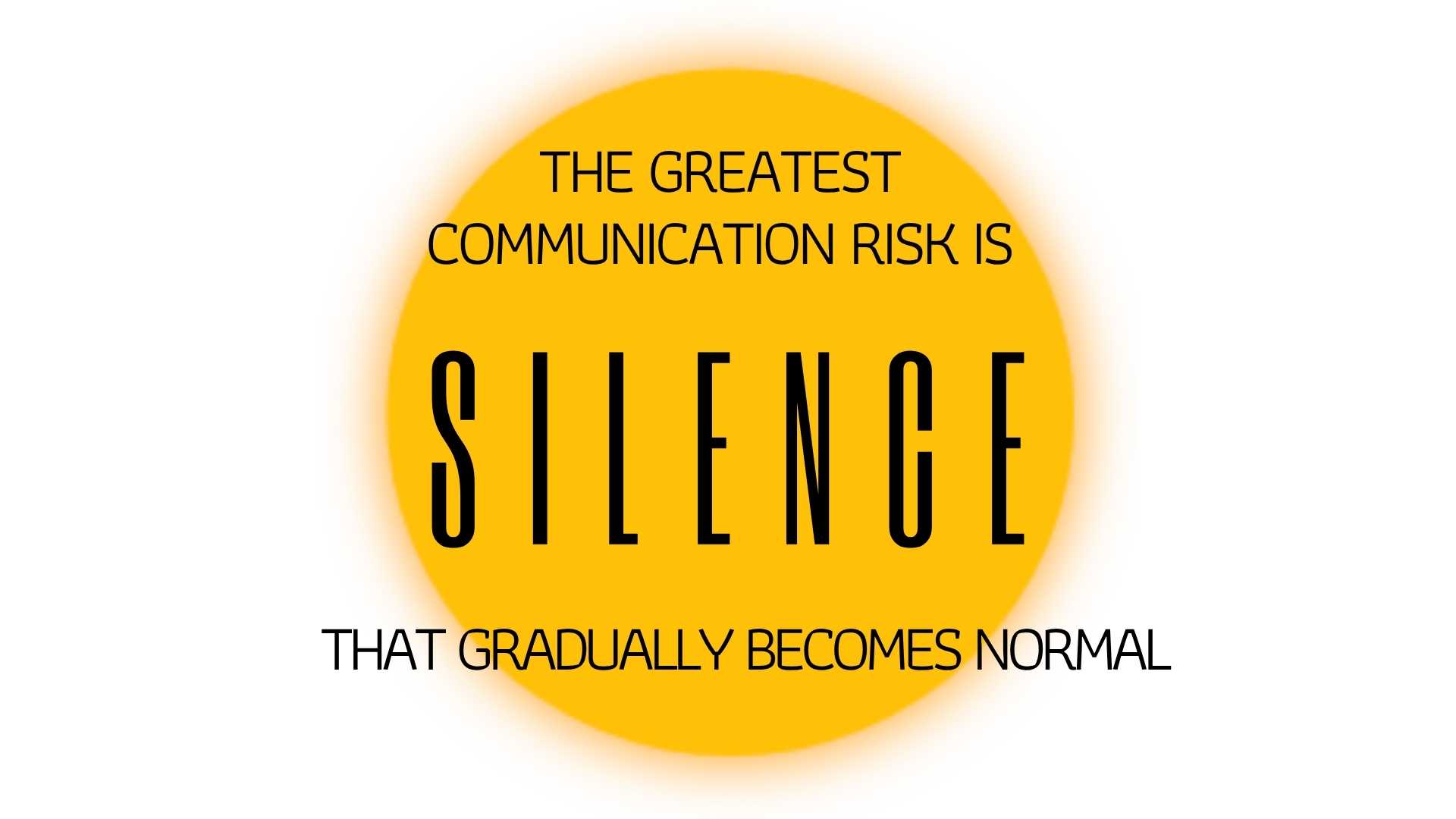
Most leadership teams devote considerable attention to the information flowing through their organisations.
Project milestones, generation figures, regulatory developments, financial performance, stakeholder concerns, and safety indicators are reviewed with increasing sophistication. Reporting systems become more robust as organisations grow, creating the impression that leaders have a comprehensive view of what is happening.
But some of the most valuable information inside an organisation never appears in a dashboard, review pack, or board presentation. It remains with people who choose not to share it. A concern that feels unnecessary to raise. An assumption left unchallenged. A question edited before it is asked. A perspective withheld because experience suggests it is unlikely to influence the outcome.
When such moments become commonplace, organisations face a challenge that is difficult to detect. Leadership loses access to information it does not know is missing.
In sectors such as power, energy and infrastructure, where decisions carry operational, regulatory, and financial consequences over long time horizons, this deserves attention. The quality of leadership decisions depends not only on the information being reported, but also on the perspectives, concerns and questions that accompany it.
Silence Is Usually Learned
Silence at an organisational level is often explained as a matter of personality. Some teams are considered naturally vocal, while others are seen as more reserved. This explanation is convenient, though it rarely tells the full story.
People pay attention to consequences. They notice whether questions receive thoughtful consideration or are brushed aside. They observe how disagreement is handled. They remember whether feedback led to discussion, action or indifference. Over time, these experiences shape behaviour more effectively than any communication policy.
Every organisation teaches its people what is safe to discuss. The lesson is rarely explicit. It emerges through everyday interactions. A challenge interpreted as resistance. A decision announced without context. Feedback acknowledged politely before disappearing into silence.
Eventually, people learn where participation creates value and where it merely consumes energy. They contribute what is necessary, share what is expected, and become increasingly selective about offering perspectives that may complicate the conversation.
Silence, in that sense, is often a rational response to the environment people experience.
When Communication Narrows
The consequences are subtle. Communication does not stop. In many cases, it becomes more efficient. Meetings run smoothly, reporting improves, and discussions remain focused.
What begins to disappear is dialogue.
Conversations become centred on updates, deliverables and immediate priorities. Questions about uncertainty, emerging risks or alternative interpretations become less common. The organisation remains informed, but its collective judgement becomes less visible.
This creates one of the more persistent leadership blind spots. Silence is often mistaken for agreement. Sometimes it reflects genuine alignment. High-performing teams do not require constant debate. But silence can also indicate caution, fatigue, or a belief that additional perspectives are unlikely to influence outcomes.
The challenge for leaders is that these conditions can look remarkably similar from the outside.
The Cost of Missing Early Signals
Most significant organisational problems are preceded by smaller signals. Someone notices an inconsistency. A frontline team identifies an emerging concern. An assumption survives without scrutiny. A risk remains confined to informal conversations rather than entering formal decision-making. Across large projects and regulated businesses, such signals frequently exist long before they become visible in reports.
Whether they travel depends largely on whether people believe there is value in raising them. This is why organisational silence is more than a communication issue. It is a decision-quality issue.
When concerns remain local and assumptions go unchallenged, organisations become less capable of identifying risk, adapting to change, and responding intelligently to complexity. The cost is not merely lower engagement. The cost is weaker organisational judgement.
Experienced leaders recognise the pattern indirectly. Discussions become increasingly predictable. The same voices dominate meetings. Agreement arrives unusually quickly. Operational surprises occur more frequently than expected. Feedback mechanisms exist, but attract limited participation.
Taken individually, these signs reveal little. Taken together, they may indicate that important perspectives are no longer reaching the room.
Listening and Inviting
Many organisations respond by encouraging people to speak up. Town halls are conducted, open-door policies are reinforced, and feedback channels are expanded. These measures have value, though they address only part of the issue.
Availability and participation are not the same thing. An open door creates the possibility of conversation. It does not create the conditions that make conversation likely.
People contribute when experience suggests that doing so is worthwhile. They pay attention to how leaders respond to difficult questions, whether disagreement is met with curiosity or defensiveness, and whether decisions are explained or merely announced. Most importantly, they look for evidence that their contribution travelled somewhere meaningful.
Dialogue grows when people can see a connection between what they say and how the organisation learns.
Rebuilding Dialogue
Addressing organisational silence rarely requires a large culture programme. Mostly it requires leaders to communicate differently.
That begins with explaining decisions rather than simply communicating outcomes. Context helps people understand trade-offs and constraints.
It requires treating disagreement as a legitimate contribution to decision-making rather than a challenge to authority.
It requires creating space for reflection alongside reporting, allowing conversations about uncertainty, emerging risks and lessons learned to sit alongside operational updates.
It also requires leaders to acknowledge uncertainty honestly. In complex environments, credibility grows when people understand both what is known and what remains unresolved.
Finally, feedback must travel somewhere visible. People do not expect every suggestion to be adopted. They do expect evidence that it was considered.
A Useful Leadership Indicator
As organisations grow, reporting systems generally become stronger. The distance between decision-makers and operational reality can also increase. The resulting risk is subtle. Leaders can become highly informed about what is happening, while becoming less aware of what is no longer being discussed.
That is why patterns of silence deserve attention. They offer insight into trust, decision quality, and organisational learning long before weaknesses appear in performance metrics or project outcomes.
The leadership challenge is not to eliminate silence. Every organisation needs focus, discipline and clear decision-making. The challenge is recognising when silence has stopped being a sign of alignment, and started becoming a sign of withdrawal.
By the time the difference becomes obvious, the organisation has often been signalling it for far longer than leadership realises.
How would you know if important perspectives had quietly stopped reaching leadership?
_________________________
Want more insights like this?
Click here to join our WhatsApp Channel for strategic communications insights, leadership perspectives, industry observations, in-depth analysis, and practical communications tips.
_________________________
Also read: Infrastructure Has Started Competing for Trust