
A disagreement over a convocation invitation would ordinarily remain a disagreement over a convocation invitation.
At National Academy of Legal Studies and Research (NALSAR) University of Law, Hyderabad, it became a question about professional enrolment, institutional authority and the conduct expected of future lawyers.
A section of the 2026 graduating batch objected to the proposed invitation of the Hon’ble Chief Justice of India (CJI), Justice Surya Kant, as chief guest for their convocation. Their representation followed proceedings concerning alleged police excesses during a July 20 protest in Delhi and reported oral observations by the CJI that the students considered dismissive of those concerns.
The controversy then moved beyond the university. On August 13, the Chairman, Bar Council of India (BCI), initially directed that NALSAR’s 2026 graduates should not be enrolled as advocates until further orders and sought information about students and others allegedly involved in the campaign. The direction was subsequently withdrawn by the BCI, the entire batch was permitted to seek enrolment, and proceedings against the batch were later closed.
On August 14, the Hon’ble Supreme Court questioned the BCI’s intervention. The CJI described the action as unnecessary and said that even if the students were wrong, they had a right to protest peacefully. The Court also directed that no punitive action be taken against students or faculty members in connection with the controversy while the matter is considered.
The facts of the episode will continue to be debated. But the more interesting question is what it tells us about independence inside the legal profession.
When dissent becomes a question of professional identity
The students’ objection was based partly on their reading of the Supreme Court proceedings. That reading was subsequently contested by the CJI, who clarified that the Court had not refused to hear the matter and that the lawyers seeking urgent listing had not filed a properly constituted petition.
Students can misunderstand a judicial proceeding. Lawyers can misunderstand a judgment. Senior counsel can misread a regulatory position. Professional life is full of disagreement, correction and reconsideration.
Being wrong is therefore not, by itself, evidence of professional unfitness.
But what happens when the disagreement is directed towards a powerful institution or one of its most senior office-holders?
The legal profession depends on people being willing to say that an argument is flawed, a precedent deserves reconsideration, a regulator has exceeded its authority or a client’s preferred course is legally unsound. The ability to question is woven into the work itself.
That makes the NALSAR episode more than a dispute over a ceremonial invitation. It raises a question about the professional identity that law schools and professional bodies are preparing young lawyers to carry into practice.
Being professionally independent requires the capacity to question authority, even when the authority being questioned is part of the profession itself.
What happens when institutional authority responds?
The BCI’s initial response makes this question particularly consequential because enrolment is the gateway to professional practice.
The BCI’s stated concern was framed around dignity, discipline and professional standards. Those are legitimate concerns for a regulator of a profession entrusted with the administration of justice.
But the initial direction extended to the entire graduating batch, even though the controversy involved only a section of students.
The subsequent BCI position acknowledged that the vast majority of the batch had not participated in any alleged act of disrespect and restored their right to seek enrolment.
This raises another question: how should a regulator respond when the conduct it is concerned about is disputed, responsibility is uneven and the consequences of its response are potentially far-reaching?
The issue is one of proportionality, but also of institutional credibility.
A regulator must be able to act when professional standards are genuinely threatened. At the same time, the credibility of that authority depends on a visible connection between conduct, responsibility and consequence.
There is another dimension.
Institutions can experience public criticism as a challenge to their authority, particularly when the criticism comes from people who occupy a lower position in the institutional hierarchy. That does not tell us why any particular actor responds in a particular way. It does, however, help explain why disagreements involving status and institutional identity can escalate quickly.
The response then becomes part of the story.
Institutional authority is strongest when the exercise of that authority remains proportionate to the conduct it seeks to address.
A profession cannot outsource independent judgment
The students involved in the controversy are preparing to enter a profession whose daily work requires independent judgment.
A junior lawyer may question a partner’s strategy. Counsel may challenge an established interpretation of law. An in-house lawyer may advise business leadership against a commercially attractive course. A lawyer may have to tell a client that the position it strongly prefers cannot responsibly be defended.
These are expressions of professional identity and responsibility.
But independence does not make every act of dissent defensible. A lawyer who disagrees remains accountable for accuracy, professional restraint and the manner in which that disagreement is expressed.
That is why the distinction between independence and impunity matters. Independence is essential to legal practice. Impunity has no place in it.
The Supreme Court’s response on August 14 added another dimension. The CJI reportedly emphasised that even if the students were wrong, peaceful protest remained within their rights. He then went further, asking the students to obtain their licences, join the Supreme Court Bar and undertake legal-aid work, describing this as a “befitting answer” to those who had caused an impediment to their professional careers.
Whether that invitation ultimately resolves anything is a separate question. But it shows that an institution’s response to dissent can shape what follows the disagreement: exclusion from the professional community, continued engagement with it, or something in between.
That is an important distinction for a profession concerned about its future. It cannot decide what dissent means only by asking whether the dissenters were right. It also has to consider what place those dissenters will occupy after the disagreement is over.
The correctness of a position and the legitimacy of expressing it are related questions, but they are not the same question.
A legal profession that expects independent judgment has to make room for that distinction.
Professional independence means retaining the capacity to question authority while remaining responsible for how that capacity is exercised.
The Independence Test
But how do we know whether an institution is actually making room for that kind of independence?
The NALSAR episode suggests one way of thinking about it.
When disagreement reaches an institution, four questions can help distinguish legitimate independence from a breakdown of professional responsibility.
→ What is being challenged?
A particular decision? An individual? An institutional policy? Or the legitimacy of the institution itself?
→ How is it being challenged?
Through reasoned criticism, lawful protest and argument? Or through intimidation, personal attack, disruption or conduct that crosses professional boundaries?
→ How is the institution responding?
Through dialogue, evidence and proportionate process? Or by treating disagreement itself as disloyalty?
→ What responsibility accompanies the independence being exercised?
The person challenging authority remains accountable for accuracy, method and consequence.
We may call this the Independence Test.
It refuses an easy answer. It does not assume that every dissenting voice is right. It does not assume that every institutional response is wrong. It asks whether both sides are capable of holding independence and responsibility at the same time.
This is significant inside law firms, universities and professional bodies. A firm’s culture is revealed when an associate questions a partner. A chamber’s culture is revealed when a junior raises an ethical concern. A legal department’s culture is revealed when counsel challenges the assumptions of business leadership.
Disagreement will always exist. The important question is what the institution teaches people to expect when they express their disagreement.
A law school teaches through its curriculum. A regulator teaches through its exercise of power. Senior lawyers teach through their responses to those who disagree with them.
A profession does not merely teach independence by telling young lawyers that they may disagree. It teaches independence by showing them what happens after they do.
Parting Thoughts
On the eve of India’s 80th Independence Day, the country will naturally reflect on the freedom to question authority that lies deep within its constitutional foundations.
For the legal profession, that reflection has a more immediate meaning.
The lawyers entering practice today will spend their careers navigating institutions they are expected to respect, represent and, at times, challenge. They will need the independence to question authority the discipline to do so responsibly, and the confidence to remain part of the profession even when they disagree with it.
Perhaps that is the more demanding measure of an independent profession: whether disagreement can coexist with belonging.
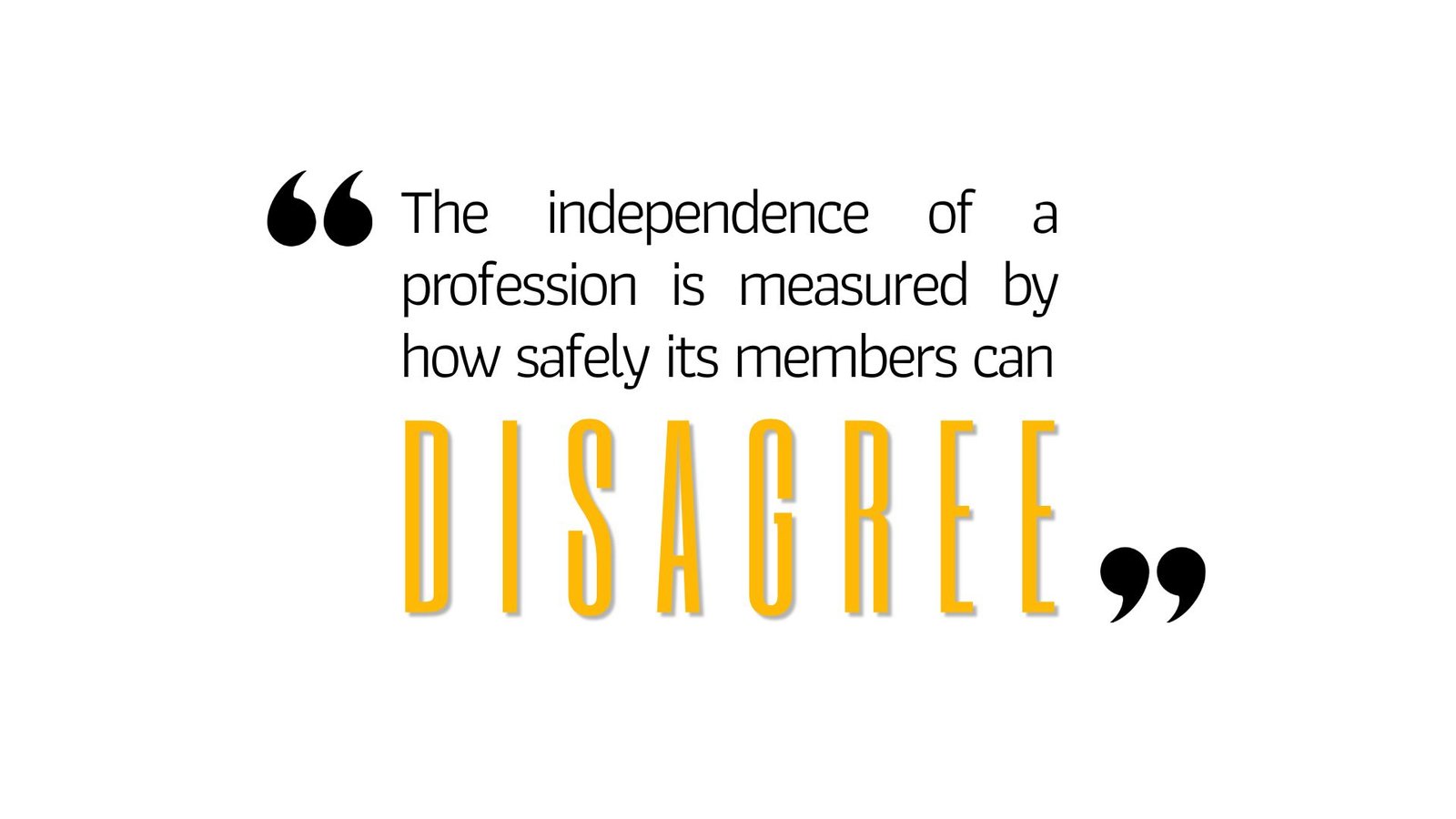
The independence of a profession may ultimately be measured by how safely its members can disagree.
______________________
Continue the conversation
Join our WhatsApp Channel for insights on legal practice, professional reputation, strategic communications, leadership, client trust, and the future of the legal profession.
______________________
Also read: If Lawyers Cannot Promise Certainty, What Are Clients Really Paying For?