
Every successful law firm eventually encounters a moment that is easy to describe and surprisingly difficult to understand.
A founding partner retires. A long-standing client relationship changes hands. Leadership passes to a younger generation. Around the partnership table, the conversation is usually practical. Which partner knows the client best? Who understands the commercial context? How should responsibilities be redistributed?
These are sensible, but incomplete questions.
Somewhere beneath them lies another question. Clients may never articulate it, but it quietly shapes every transition. They are not simply wondering who will handle the next matter. They are trying to determine whether the judgment they have relied upon for years still resides within the firm.
Most law firms think about succession as the transfer of relationships. Clients often experience it as a test of continuity.
That difference is easy to overlook because, during years of growth, the reputation of a firm and the reputation of its leading partners appear almost indistinguishable.
Founders become the public face of the institution. Their names carry authority. Their judgment attracts clients. Their presence comes to symbolise the firm’s identity.
The real test arrives only when that presence is no longer guaranteed.
Why Clients Trust More Than They Can Verify
Lawyers are accustomed to evaluating arguments through evidence, authority and reasoning. Clients rarely have that luxury.
Even the most sophisticated General Counsel cannot independently examine every legal opinion in the way another lawyer might. Decisions are made in conditions of uncertainty. Commercial realities evolve quickly. Risks are often judged before outcomes become visible.
Behavioural science has long suggested that, in uncertain environments, people depend less on complete information than on reliable signals. Trust is rarely built through one dramatic demonstration of expertise. It emerges from repeated experiences that create confidence in how decisions are made.
This helps explain something that legal directories and rankings cannot fully capture.
When clients remain loyal to a firm for decades, they are responding to more than technical excellence. They begin to recognise a particular quality of judgment. They notice consistency across different matters. Different partners may lead different mandates, but the advice reflects the same intellectual discipline, the same commercial awareness and the same professional standards.
Clients rarely describe these patterns explicitly. They simply conclude that this is a firm whose judgment can be trusted.
When Judgment Becomes Institutional
This raises a question that extends well beyond succession planning.
Can professional judgment belong to an institution?
Knowledge certainly can. Precedents, research, playbooks and databases preserve information with increasing sophistication. Artificial Intelligence (AI) is making that information even more accessible.
Judgment follows a different path.
It is formed through years of experience, difficult conversations, competing viewpoints, professional restraint and decisions whose significance often becomes clear only in hindsight. It reflects not only what lawyers know, but how they think when the law is uncertain, facts are incomplete, and commercial consequences extend beyond the immediate dispute.
For that reason, professional judgment is assumed to reside within individuals.
But the most enduring law firms suggest another possibility.
Over time, judgment can become part of an institution’s character.
Not because it has been written into a manual, but because it has been transmitted through mentoring, shared standards, internal debate and a culture that quietly teaches younger lawyers how the firm approaches difficult decisions. Even before clients notice it externally, that way of thinking becomes internally recognisable.
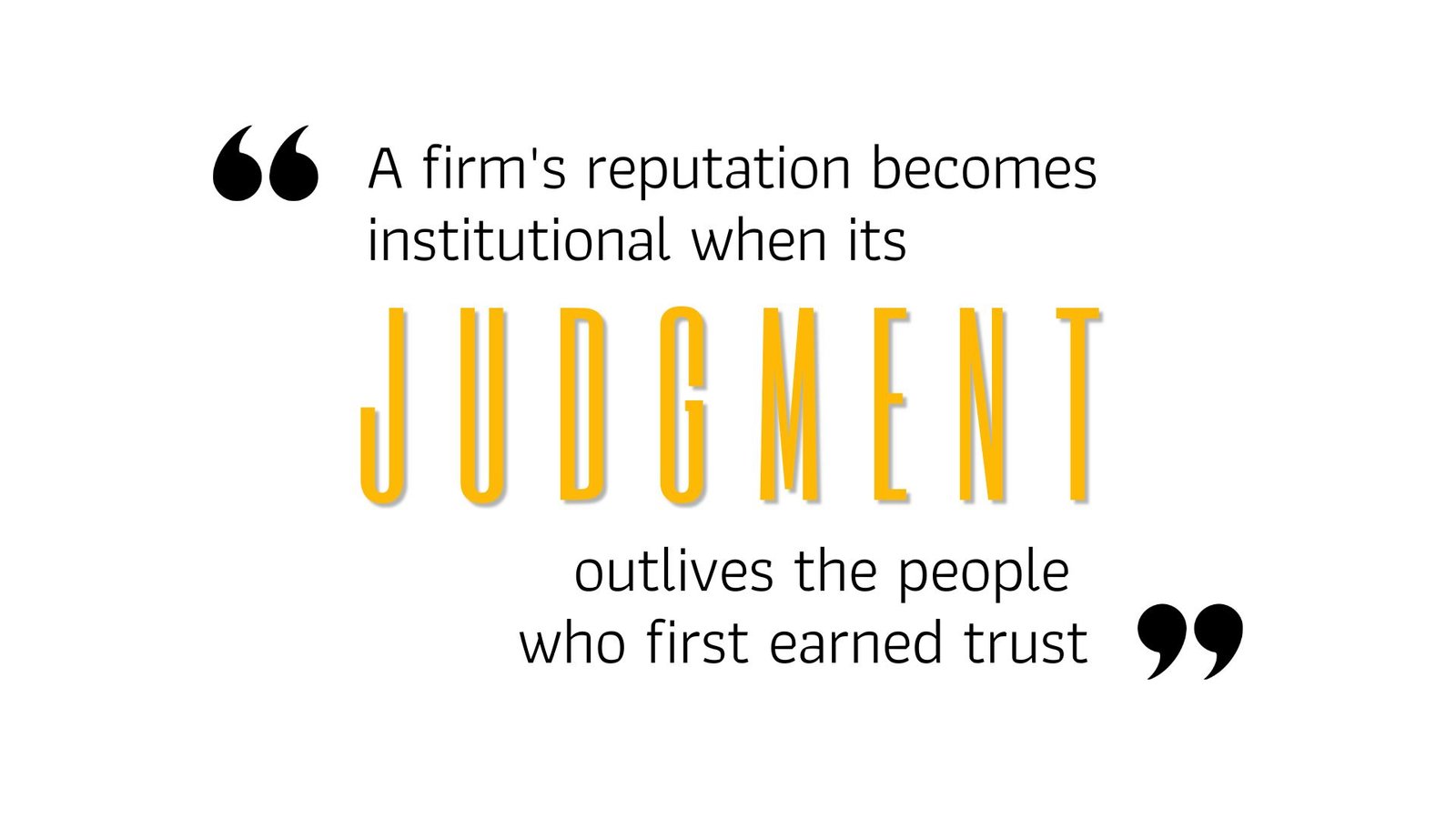
Perhaps this is the point at which institutional reputation truly begins.
Not when a firm’s name becomes widely known, but when its judgment is no longer dependent upon the continued presence of those who first established it.
Only then does the firm’s reputation begin to outgrow individual careers.
What Great Law Firms Really Leave Behind
Professional institutions are often admired for their longevity, but longevity is only the visible outcome of something deeper.
The world’s oldest universities continue to command respect despite generations of changing faculty. Leading hospitals inspire confidence regardless of which physician a patient meets first. Their reputation survives because each generation inherits standards of judgment that are preserved, questioned, refined, and passed forward rather than recreated from the beginning.
Law firms face the same challenge, although they do not always describe it in those terms.
Growth can be measured. Revenue can be measured. Market share can be measured. The continuity of judgment is far harder to quantify, even though it may prove to be the institution’s most valuable asset.
Seen in this light, leadership acquires a different meaning. Its enduring contribution is not merely the matters won, the clients acquired, or the offices opened. Leadership succeeds when it leaves behind a way of thinking that others can faithfully inherit without merely imitating personalities.
That inheritance rarely happens by accident. It depends upon how a firm’s judgment is captured, discussed, and consistently expressed across generations of lawyers.
Mentoring remains indispensable, but institutions also need deliberate ways of articulating their philosophy, decision-making and professional standards. Strategic communication, understood in this sense, is less about visibility than about preserving institutional identity.
Parting Thoughts
Perhaps that is the question every managing partner should carry into discussions about the future of the firm.
When today’s most respected partners eventually step away, what exactly will clients believe remains?
If the answer is little more than a different name on the engagement letter, succession has changed the faces without strengthening the institution.
If the answer is that clients still recognise the same quality of judgment, expressed through different individuals, something much more significant has taken place.
The firm’s reputation has ceased to belong to its founders.
It has become part of the institution itself.
______________________
Continue the conversation
Join our WhatsApp Channel for insights on legal practice, professional reputation, strategic communications, leadership, client trust, and the future of the legal profession.
______________________
Also read: If AI Can Write Like Every Lawyer, What Will Clients Trust?
India Is Preparing for Retail Electricity Competition. Is the Ecosystem Ready?
India’s Green Hydrogen Mission Is Building Its Commercial Architecture