
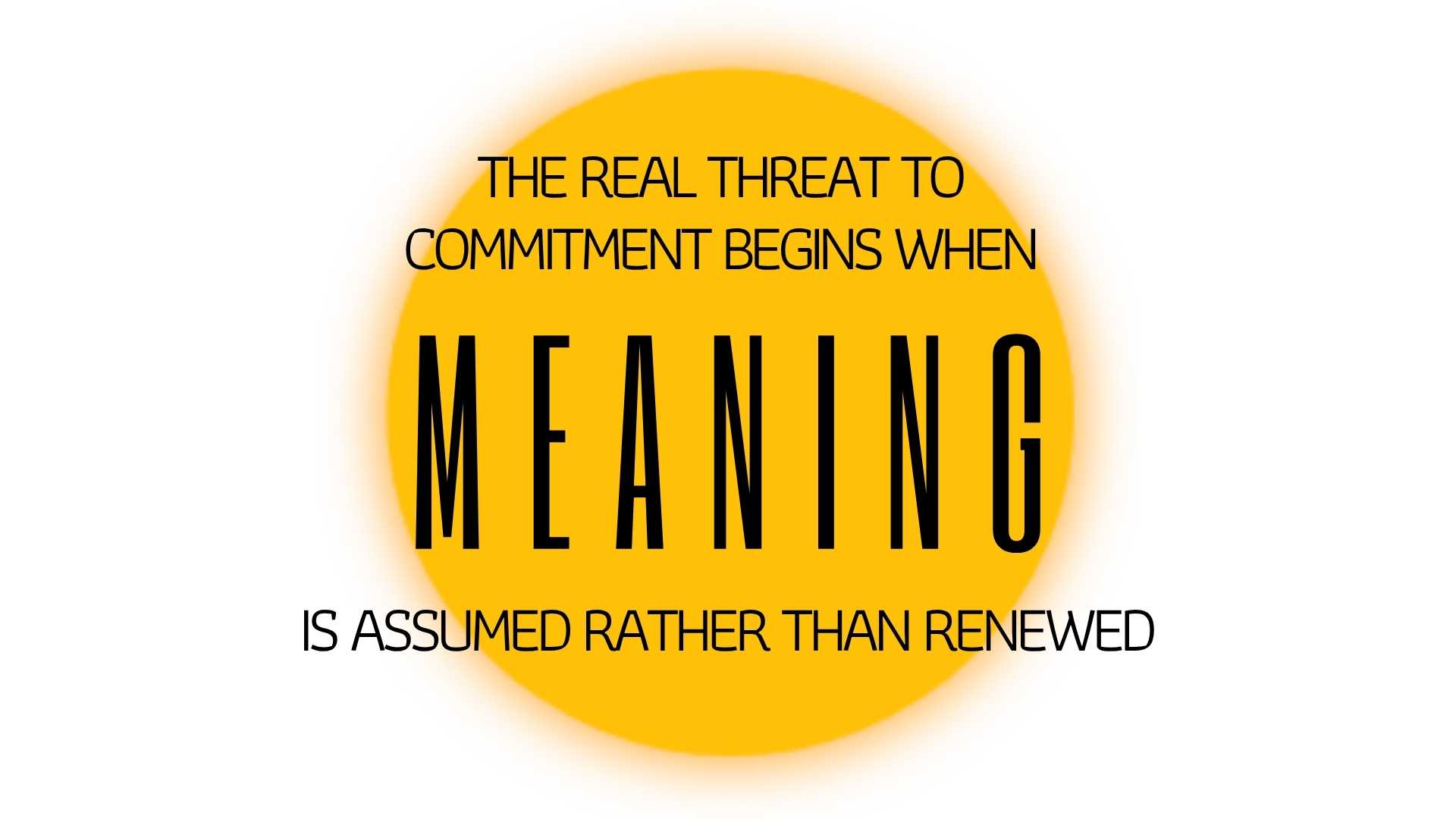
Most organisations do not lose their sense of purpose overnight. They lose it gradually, mostly during periods of growth.
As businesses expand, leadership attention naturally shifts towards execution. New projects demand oversight, stakeholder expectations increase, regulatory obligations multiply, and organisational structures become more complex. The discipline required to manage a larger enterprise becomes increasingly important.
The challenge emerges when the language of execution begins to crowd out the language of meaning. Conversations become dominated by timelines, milestones, approvals, risks, budgets, and delivery targets. Communication remains frequent, but its character changes. People hear a great deal about what is happening across the organisation and considerably less about why it matters.
In many organisations, this shift occurs so gradually that it passes unnoticed. Projects move forward. Performance remains acceptable. Dashboards show progress. But something important begins to weaken.
When context becomes assumed
At the outset of an organisation’s journey, purpose is usually visible. Teams are smaller. Decisions are easier to understand. Employees have direct exposure to the reasoning behind strategic choices and can see how their work contributes to broader ambitions.
Growth changes that equation. Senior leaders continue to operate with a view of the wider landscape. They understand the market forces, policy developments, investment priorities, competitive pressures, and long-term objectives shaping the organisation’s decisions.
Most employees experience only a portion of that reality. With time, context becomes assumed rather than explained.
This is particularly relevant in the energy sector, where organisations increasingly span renewable energy, transmission, storage, conventional generation, digitalisation, and emerging technologies. Different functions often experience the same organisation in very different ways.
A regulatory team, a project execution team, an operations group, and a finance function may all be working towards the same strategic objective while interpreting it through entirely different lenses.
Without deliberate effort to connect those perspectives, the organisation gradually loses a shared understanding of its direction.
The hidden cost of losing meaning
Leaders often assume that purpose, once articulated, remains understood. But experience suggests otherwise. Meaning requires renewal.
People do not derive meaning from activity alone. They derive it from understanding how their effort connects to something larger than the task immediately in front of them.
When those connections become less visible, work begins to narrow. Individuals continue performing their responsibilities, though their relationship with the organisation changes. Collaboration becomes more transactional. Initiative becomes more selective. Innovation often slows. Teams focus on their immediate objectives while losing sight of broader organisational priorities.
Many leadership teams interpret these symptoms as capability gaps, engagement issues, or resistance to change. Mostly they are witnessing something else.
People understand the activity. But they have lost visibility into the contribution. This distinction matters, particularly in energy and infrastructure sectors characterised by long investment horizons and delayed outcomes.
A transmission project, generation asset, storage programme, or digital transformation initiative may take years before its full impact becomes visible. The individuals working on those efforts need more than operational direction. They need a continuing understanding of how today’s work contributes to tomorrow’s organisation.
Without that connection, commitment gradually becomes transactional. Responsibilities are fulfilled, but ownership becomes narrower.
A leadership responsibility disguised as a communications issue
Maintaining organisational meaning is often treated as a communications challenge. It is fundamentally a leadership responsibility. Because communication provides the mechanism, but leadership provides the intent.”
The strongest organisations make a conscious effort to reconnect execution with purpose on an ongoing basis. They do not assume employees automatically understand why a priority matters simply because leadership understands it.
They explain the reasoning behind decisions. They revisit strategic choices. They place operational developments within a broader organisational context.
Just as importantly, they recognise that progress requires interpretation.
Most organisations communicate activity effectively. They report projects completed, approvals secured, investments made, and targets achieved. But fewer devote equal attention to explaining what those developments mean.
What capability has been created? What challenge has been addressed? What has changed because of the effort? What has the organisation learned? How has this moved the organisation closer to its longer-term ambitions?
These conversations help people connect effort with outcome and activity with purpose.
They also reinforce an important idea that organisations are not merely delivery engines. They are evolving enterprises shaped by choices, trade-offs, successes, setbacks, and learning.
Keeping the story alive
Leaders must also recognise that meaning is rarely experienced in identical ways. An engineer, a regulatory professional, a commercial manager, an operator, and a member of the leadership team may each derive purpose from different aspects of the same mission.
Maintaining a shared narrative does not require uniformity of perspective. It requires sufficient clarity for those different perspectives to remain connected to a common direction.
As organisations grow, investment in systems, governance, controls, and performance management becomes unavoidable. These mechanisms strengthen discipline and accountability. They improve execution.
But they cannot answer a question that every employee eventually asks, whether explicitly or implicitly, as to why does this work matter?
The organisations that sustain commitment through periods of growth are usually those that continue answering that question long after they believe it has already been answered.
Because organisational meaning rarely disappears through a single decision or event. Mostly, it fades when leaders stop explaining the connections between effort and impact, today’s priorities and tomorrow’s ambitions, individual contribution and collective purpose.
When those connections remain visible, growth strengthens an organisation. When they do not, growth can slowly fragment it.
Can people across your organisation explain not only what they do, but why it matters to the organisation’s future?
_________________________
Want more insights like this?
Click here to join our WhatsApp Channel for strategic communications insights, leadership perspectives, industry observations, in-depth analysis, and practical communications tips.
_________________________
Also read: Offshore Wind’s Hardest Work Begins Onshore