“We want this to be a long-term partnership.” A senior commercial executive says it to the lawyer drafting the agreement.
A few weeks later, the draft comes back with detailed termination rights, extensive indemnities, multiple approval mechanisms and carefully negotiated remedies for breach.
The executive reads it and pauses. “Why does this sound as though we are expecting the relationship to fail?”
The lawyer may have done nothing wrong. Every provision may have a sound commercial or legal rationale. Still something has changed. The business conversation described one relationship, while the contract appears to describe another.
Lawyers are trained to examine contracts for rights, obligations, liabilities and remedies. But the people who have to perform the agreement often read them differently; they look for signals about how the other side expects the relationship to work.
The question is whether those readings tell the same story.
The story begins before the first clause
A contract begins with why the parties are entering into it. There is an objective, a set of expectations, dependencies, uncertainties and assumptions about what may happen over time.
The lawyer enters that story and gives it legal form.
Legal scholarship has explored this narrative dimension of transactional documents, including the way parties’ goals, expectations and concerns find expression in contractual drafting. The transactional lawyer has even been described as a kind of narrative agent, interpreting the client’s objectives and translating them into the document.
The problem begins when that translation changes the meaning.
Suppose the commercial team describes the counterparty as a strategic partner, while the contract gives one party extensive unilateral control over decisions that materially affect the other.
That may be justified by bargaining power, financing arrangements, regulation or risk allocation.
But the document is communicating something alongside the legal allocation. It is saying that this partnership operates within carefully controlled boundaries.
Perhaps that is exactly what the parties intend. Perhaps it is not. This difference is important.
A contract records the bargain, but it also records the parties’ expectations of one another.
What does the contract reveal about what the parties fear?
Risk allocation can be revealing.
Look at what receives the most attention. What requires prior approval? What triggers termination? Which risks receive detailed indemnities? Where are audit rights extensive? What happens when circumstances change?
These provisions have obvious legal and commercial functions. They can also reveal where the parties believe the relationship may come under strain. A protective clause does not automatically signal distrust. A sophisticated contract may need strong safeguards because the transaction is valuable or the consequences of failure are significant.
The more useful question is what the architecture communicates.
Imagine two long-term agreements with broadly similar risk allocation. One establishes clear processes for consultation, escalation and adaptation. The other places greater emphasis on default, remedies and unilateral rights. Both may be legally sound, but the parties may experience them differently.
Behavioural science helps explain why. People interpret language through framing, context, and perceptions of fairness. The way uncertainty and responsibility are framed can influence what each side believes the other expects from it.
That becomes particularly important when circumstances change. A party encountering an unexpected event will read the relevant clause against the history of the relationship, and the expectations created along the way. The contract becomes part of that history.
What a party insists on protecting against can reveal what it expects from the relationship.
The contract acquires a second life after signature
Most contracts spend far more time being performed than being litigated.
Once signed, the document moves into procurement, finance, operations, project teams, and senior management. People use it to determine who approves a change, when payment is due, who must provide information and what happens when performance is delayed.
At that point, the contract is an operating document.
This has implications for contractual quality. Scholarship on proactive contracting and contract design increasingly considers how agreements can support coordination, communication, adaptation, and ongoing relationships alongside their traditional protective functions.
The rise of AI makes the distinction more consequential.
Technology can make drafting and review faster. It can identify clauses, compare versions and surface obligations. Technically competent contractual language may become easy to produce.
The harder question remains human: What should the agreement ask the people in the relationship to understand?
A contract can be comprehensive and still leave the people performing it unclear about priorities, responsibilities or how they should respond when circumstances change. This is where legal drafting meets communication.
The lawyer decides which version of the relationship survives
Clients rarely arrive with a fully articulated theory of their relationship.
They say:
“We need flexibility.”
“We trust them.”
“We need protection.”
“We want this to work for ten years.”
“We do not want this to become adversarial.”
Each instruction contains a question beneath it. What does flexibility mean in practice? Who exercises it? Does it require consultation or allow unilateral discretion? What exactly needs protection? Financial exposure? Operational continuity? Regulatory compliance? Bargaining power?
“Protect us” is often the beginning of the conversation, rather than the end of it. That is where listening becomes part of transactional judgment.
Before drafting, the lawyer has to understand the commercial objective, the relationship between the parties, and the concerns beneath the client’s instructions. Only then can those intentions be translated into rights, obligations, processes, and remedies.
By the time the final agreement is signed, a commercial intention may have passed through several layers of interpretation:
Business intention → Client instruction → Legal interpretation → Negotiation → Contractual language → Ooperational behaviour
Something can be lost at every stage. The transactional lawyer therefore helps determine which version of the relationship becomes legally visible. As technology makes the production of language easier, that responsibility becomes more significant.
The scarce skill may lie in knowing which questions to ask before the language is produced.
Can the three stories still be reconciled?
There is a useful way to read a significant agreement before it is signed.
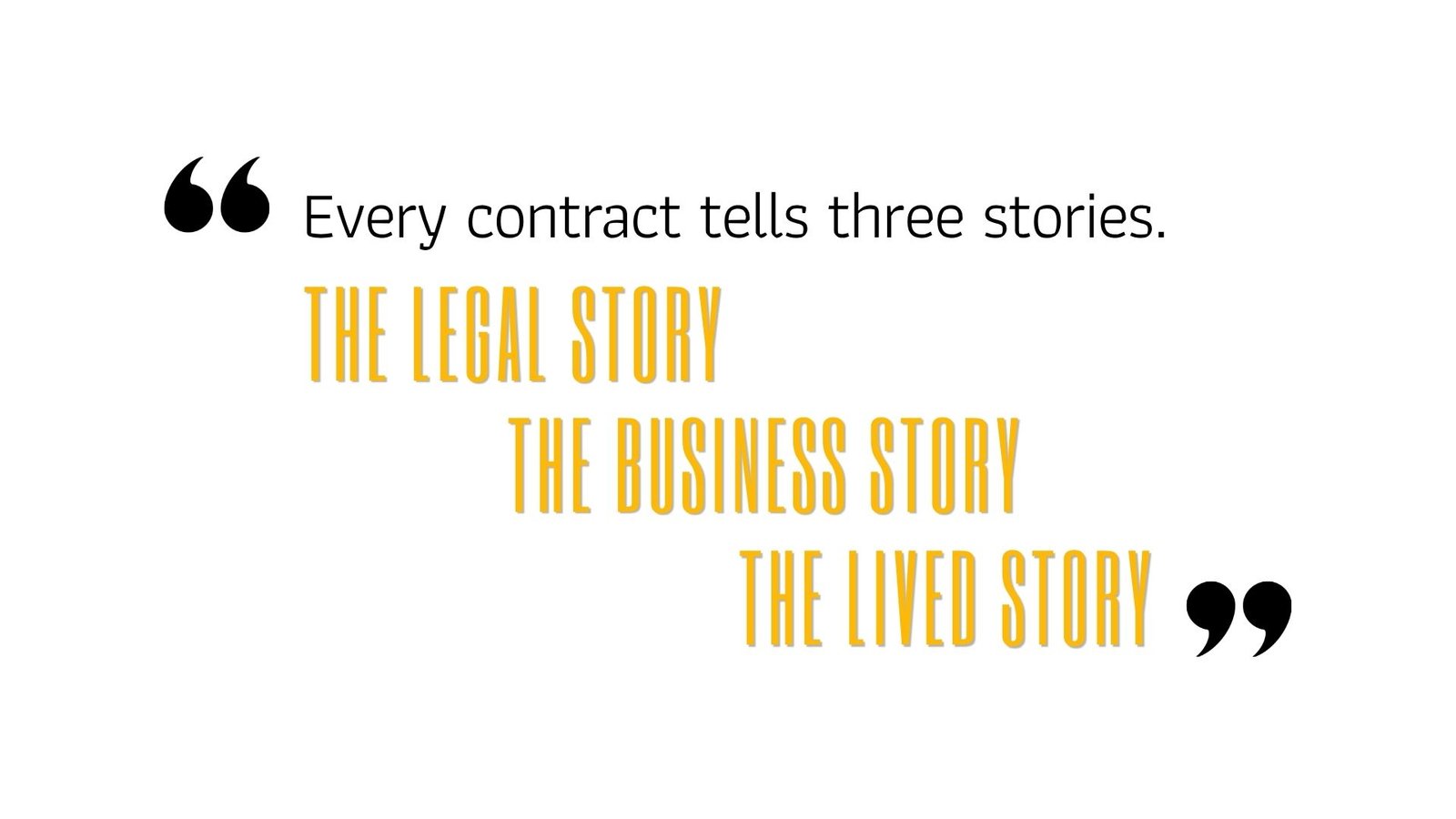
Read it first as the business story.
What do the parties believe they are building?
Then read it as the legal story.
What does the agreement actually require, permit, and protect against?
Then consider the lived story.
What will the people responsible for performing it experience when they have to use it?
The three will never be identical. And they do not need to be.
A long-term partnership can contain rigorous protections. A collaborative relationship can have strong remedies. Trust does not remove the need for contractual discipline.
The question is whether the differences are deliberate.
When the three stories pull in different directions, the consequences may appear as operational confusion, repeated renegotiation, damaged trust or eventually a dispute.
Reading a contract this way allows the lawyer to see something a clause-by-clause review can miss: whether the legal architecture is coherent with the relationship it is meant to govern.
A contract may eventually be read by a judge. For most of its life, however, it will be read by people trying to work with each other. So before asking whether every foreseeable risk has been covered, there is one further question worth asking:
What relationship does this document ask the parties to believe they have?
______________________
Continue the conversation
Join our WhatsApp Channel for insights on legal practice, professional reputation, strategic communications, leadership, client trust, and the future of the legal profession.
______________________
Also read: When Authority Scales Faster Than Judgment
Cyber Security Protects Systems. What Protects Stakeholder Confidence?
The Consumer Question Behind India’s Smart-Meter Push
What If the Most Important Skill in Legal Practice Is the One Lawyers Talk About Least?