
Some energy sector organisations become harder to run just as they become better at running themselves.
They hire stronger people, formalise processes, introduce governance and invest in better systems. But decisions that once took a conversation begin to require a meeting, a review, and another layer of validation.
The obvious explanation is bureaucracy. Sometimes it is.
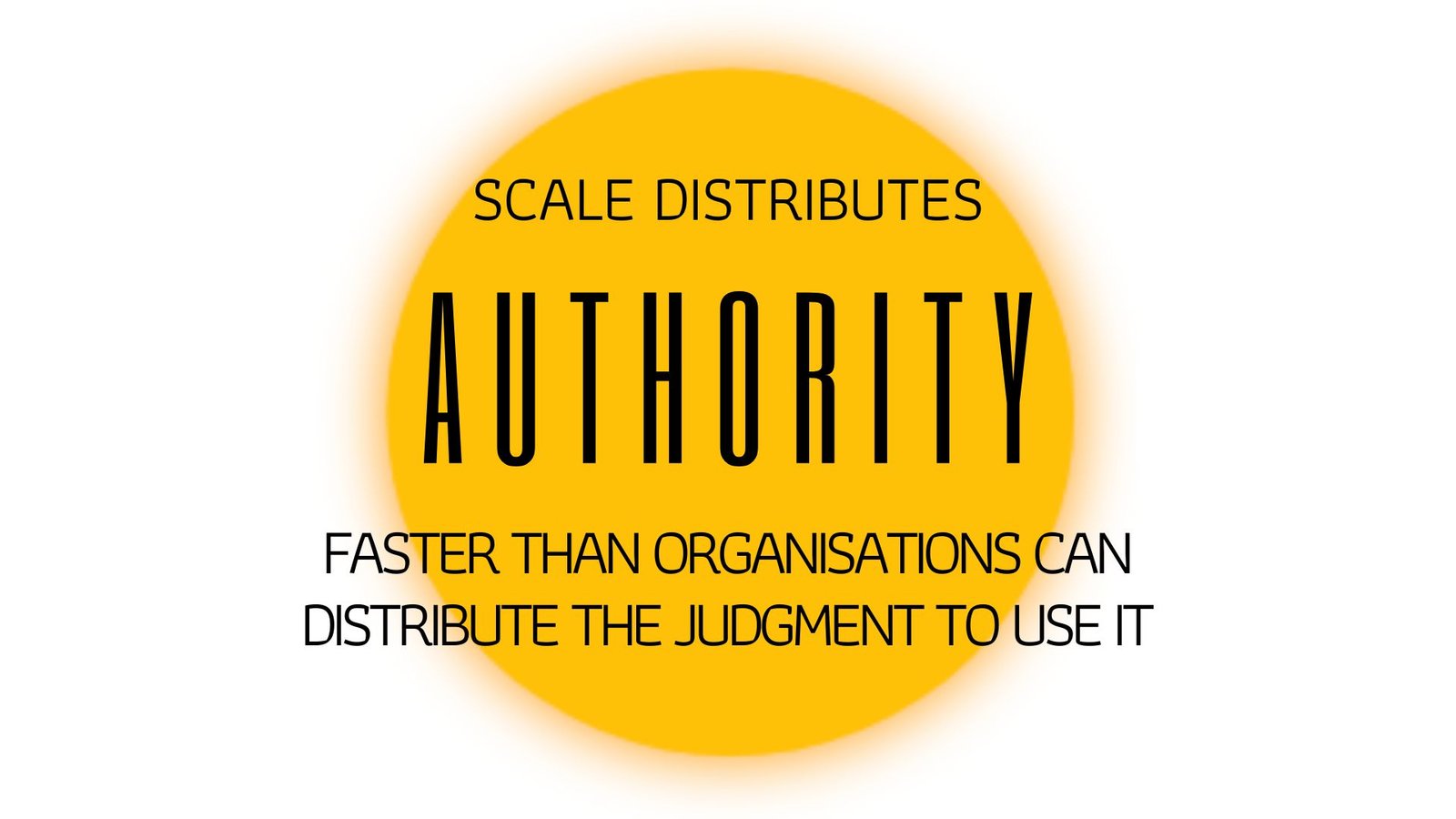
A deeper problem can emerge as an organisation grows: authority gets distributed faster than the context required to exercise it.
In a smaller organisation, people usually make sound decisions with surprisingly little formal guidance because they share something more valuable than information. They share context. They hear the conversations around important choices, observe how leaders weigh competing priorities and learn which risks are acceptable, which trade-offs matter and where the boundaries lie.
As the organisation grows, that proximity disappears. Formal systems take its place. Strategy documents, dashboards, review meetings and governance structures become more important.
The organisation gains information while losing some of the context that once made that information useful.
What disappears when an organisation grows
Proximity performs more organisational work than leaders realise.
A person who works closely with a founder or senior leadership team gradually absorbs the reasoning behind decisions without anyone deliberately teaching it. They learn what urgency means in practice. They see how commercial considerations are weighed against risk. They observe which exceptions are tolerated and which ones attract scrutiny.
Much of this knowledge remains unwritten because it has been acquired through experience.
Scale changes the equation.
A project team expands. Business units multiply. Decision-makers move further from the conversations in which priorities were formed. Leaders respond with more information, more processes, and more formal mechanisms for alignment.
Those mechanisms although necessary, still cannot reproduce everything that proximity once supplied.
The missing element is mostly decision logic: the priorities, trade-offs, risk boundaries and principles that help someone decide when the specific situation in front of them has never been discussed before.
That distinction becomes significant particularly in energy and infrastructure businesses. A project may run for years. Capital is committed well before outcomes are visible. Regulatory requirements, commercial considerations, execution pressures and stakeholder expectations can shift during that period. A strategy document can establish direction, while the organisation still has to make hundreds of consequential choices that the document could never have anticipated.
Those choices require judgment.
Delegated authority can create uncertainty
This is where a growing organisation can begin to slow itself down.
Leaders delegate authority because decisions need to move closer to the point of action. But delegation remains incomplete when the person receiving the authority does not understand how the organisation will judge the decision.
Imagine a manager facing a choice involving cost, schedule and risk. The formal delegation may make clear that the manager has authority to decide. The unwritten expectations may be much less clear.
Should schedule take precedence over cost? How much additional risk is acceptable? Which stakeholder concern should carry greater weight? When does a deviation from the original plan require escalation?
When those questions remain implicit, escalation becomes a rational response.
This is why repeated escalation should not automatically be read as weak ownership. A capable person may be perfectly willing to decide and still hesitate because the consequences of getting the decision wrong are unclear.
What are they afraid of getting wrong?
That question can reveal more than another instruction to “take ownership.”
Sometimes the fear is commercial. Sometimes it concerns regulatory scrutiny, stakeholder reaction or senior management’s response. Sometimes the person simply cannot tell which of several legitimate priorities will matter most when the decision is reviewed later.
People in that situation are asking for interpretation rather than permission.
The distinction changes the leadership response. Pressure may produce faster decisions for a while. Clearer decision boundaries can produce better independent judgment.
The context leaders carry in their heads
Senior leaders can unintentionally deepen the problem as organisations mature.
Earlier in their careers, leaders explain more. They narrate the circumstances, discuss alternatives, and connect decisions to intent. As experience accumulates, communication tends to become more compressed. The leader knows the context already, so the organisation receives the conclusion.
The leader may say that a project should proceed, a risk should be accepted, or a priority should change. The reasoning behind that choice remains largely internal.
That creates a context gap.
When the next unfamiliar situation arises, the organisation returns to the person who still carries the missing logic.
The remedy is not endless explanation. It is deliberate externalisation of the reasoning that others will need later.
Leaders need to make clear which trade-offs matter, what risks are acceptable, what cannot be compromised and which outcomes should override others. Where a consequential alternative was rejected, explaining why can be as valuable as announcing the chosen course.
Repetition matters here too.
Senior leaders can regard repetition as inefficient because they have been living with an idea for months. For someone encountering the principle in a new situation, repetition may be what turns a leadership preference into organisational understanding.
Past decisions, failures and hypothetical situations can all help people recognise how a principle should work when circumstances change.
The aim is to make the basis for judgment sufficiently clear that people can apply it without waiting for a new instruction.
The test of whether judgment has travelled
There is a more demanding test of organisational understanding than agreement in a meeting.
What happens when the leader is absent?
If a team can repeat the strategy but struggles to apply it to an unfamiliar situation, information has travelled further than judgment.
If managers repeatedly seek validation on decisions that formally sit within their authority, the organisation may have a clarity problem rather than a capability problem.
And when execution repeatedly stalls, leaders should examine interpretation before concluding that people lack discipline or ownership.
A missed deadline may have a straightforward operational cause. It may also reflect different understandings of what leadership considered the priority, which risk was acceptable or which constraint was non-negotiable.
This is why closing the loop matters.
After a consequential decision, leaders can ask a deceptively simple question: What should this decision change about how we make the next one?
That question turns a single decision into organisational learning.
It also provides a better measure of communication. A message has travelled when people have received it. Context has travelled when they can use it. Judgment has travelled when they can apply it to circumstances the leader never anticipated.
For an energy or infrastructure business, that distinction has practical consequences. Organisations cannot rely indefinitely on a handful of senior people to carry the full context behind capital allocation, project execution, regulatory choices or stakeholder trade-offs. The people closest to the decision will often have the most current information. They need enough organisational logic to interpret it responsibly.
That is where mature delegation begins.
Parting Thoughts
The goal is not to eliminate deliberation. Some decisions deserve time because their financial, regulatory, safety or stakeholder consequences warrant it. The objective is to remove the delay created by uncertainty about who should decide, what matters most and how the decision will be judged.
The most resilient organisations therefore build something more durable than faster approval chains. They make sound judgment increasingly independent of the physical presence of senior leaders.
That is a leadership responsibility, and it has a communication dimension that is easy to underestimate.
Communication becomes strategically valuable when it allows context, intent and judgment to travel beyond the people who originally held them.
Scale should distribute decision-making, not distribute uncertainty.
The ultimate test is whether good judgment can survive the absence of the person who first held it.
What decision in your organisation still depends too heavily on context that exists only in a few senior leaders’ heads?
_________________________
Want more insights like this?
Click here to join our WhatsApp Channel for strategic communications insights, leadership perspectives, industry observations, in-depth analysis, and practical communications tips.
_________________________
Also read: When the Leader Leaves, What Remains?
What Does Independence Mean Inside the Legal Profession?