
– By Mayuri Singh and Nishant Saxena
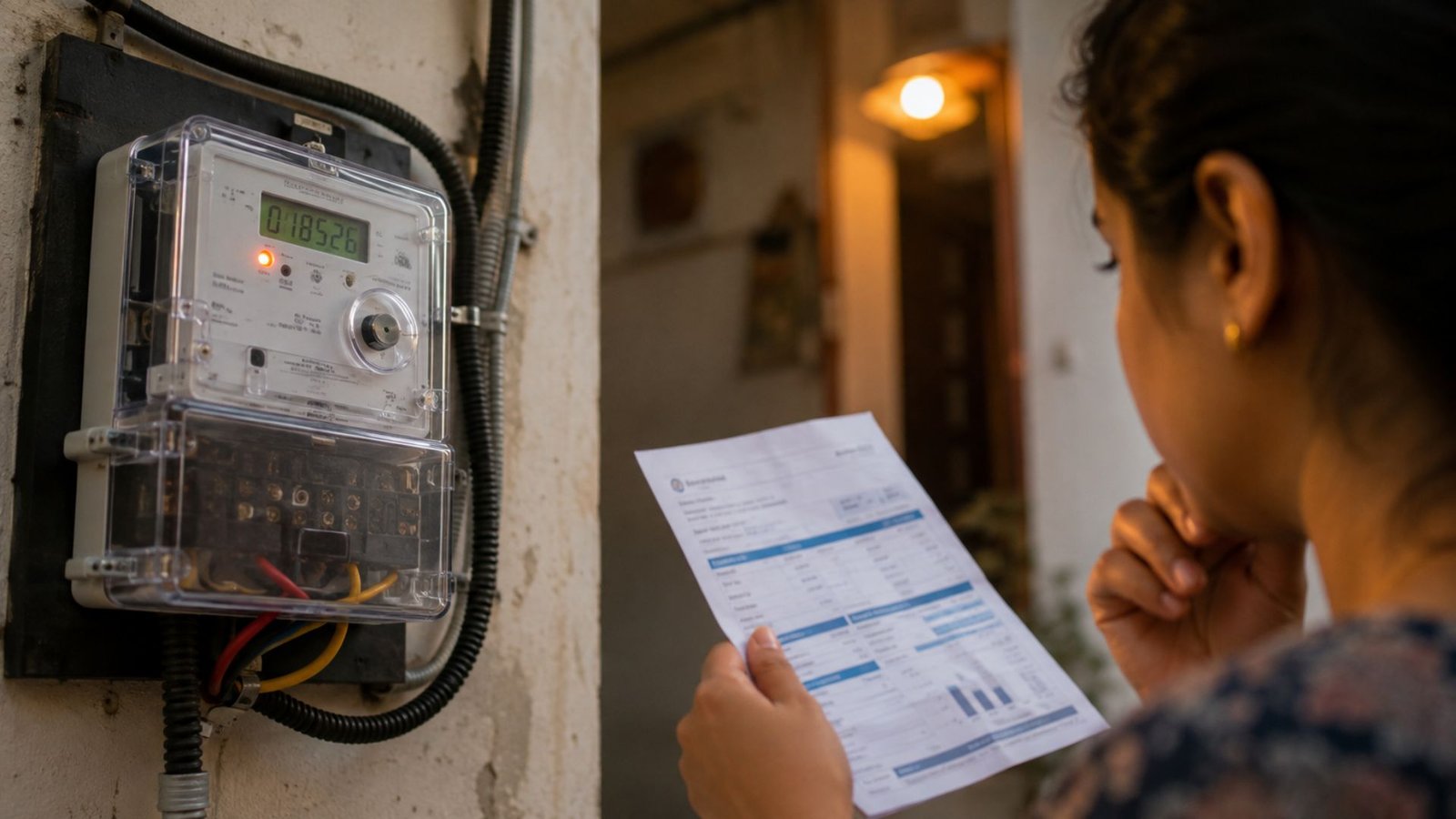
A consumer receives a sharply higher electricity bill after a smart meter is installed. The distribution utility says the meter is accurate. The consumer remains unconvinced.
There is no contradiction in those two positions.
A meter can measure consumption correctly, while the system around it leaves the consumer confused about the bill, uncertain about what has changed, or unsure how to challenge it.
That distinction is becoming important as India accelerates its smart-meter rollout. Just a few days ago, the Ministry of Power asked States and Union Territories to expedite installation of smart meters across consumer categories, clarifying that deployment should not be delayed on the question of whether billing is prepaid or postpaid.
The timing is significant. The latest parliamentary answer on consumer concerns, answered in August 2026, records 5.73 crore smart meters installed under the Revamped Distribution Sector Scheme (RDSS) by June 2026 and 7.24 crore across the country under various schemes. RDSS has sanctioned smart metering for 19.79 crore consumers, 2.05 lakh feeders and 52.53 lakh distribution transformers.
The rollout is large and its policy objective is clear: better billing and collection, improved energy accounting, and a more efficient distribution system.
The consumer experience now needs to keep pace.
A higher bill does not prove a faulty meter
Several reports from Maharashtra, Uttar Pradesh, Chhattisgarh, Himachal Pradesh and elsewhere have described consumers alleging sharply higher bills after smart-meter installation. Other complaints have involved prepaid deductions, unexpected disconnections, technical glitches, and difficulties obtaining explanations.
None of this, by itself, establishes that smart meters are inaccurate.
Electricity consumption may have increased. Summer demand can push households into higher tariff slabs. Earlier consumption may have been estimated or under-recorded. Arrears, billing-cycle changes or other billing factors can also affect the amount payable. Maharashtra’s Energy Minister has attributed many complaints to higher summer consumption and misunderstandings about billing.
But repeated complaints still tell us something worth examining. The consumer is asking a question that is different from the utility’s technical question.
The utility asks: Is the meter recording electricity correctly?
The consumer asks: Why has my bill changed, and can you show me why?
Both questions deserve an answer.
Accuracy needs to be accompanied by explanation
On the issue of consumer complaints on smart meters, the Government’s response records a substantial technical and consumer-protection framework.
Smart meters must meet relevant BIS standards. Factory Acceptance Tests are undertaken, samples are sent to third-party NABL laboratories, and check meters are to be installed when consumers complain, providing a route for independent verification.
There are also mobile applications, low-balance alerts, emergency credit, multiple recharge options and complaint-resolution mechanisms. Consumers can escalate unresolved complaints through the Consumer Grievance Redressal Forum and, thereafter, the Electricity Ombudsman.
The value of these safeguards, however, depends partly on whether the consumer can find them, understand them, and use them.
A check-meter provision is little comfort to someone who does not know that it exists. A consumption graph does not explain a higher bill if the consumer cannot connect the data to the tariff applied. An alert is less useful if the consumer does not understand what action is expected.
That is where the smart-meter debate becomes a question of communication, although not just in the conventional sense of issuing more advisories or running another awareness campaign. The system itself has to communicate.
The bill, the app, the meter, the tariff information, the recharge balance, and the grievance process should tell a coherent story about what has happened to the consumer’s electricity account.
The consumer interface is becoming part of the infrastructure
Smart metering changes the relationship between the consumer and the distribution utility.
The traditional meter largely sat in the background. The smart-meter ecosystem introduces automated readings, consumption data, digital payments, prepaid balances, alerts, and remote processes into the consumer’s everyday interaction with electricity.
This creates a different expectation. Consumers need to understand what has changed before they are confronted with the consequences.
Uttar Pradesh offers a useful illustration of why this is significant. Earlier this year, complaints around prepaid smart meters included sudden disconnections, technical glitches, unclear deductions and cases in which consumers reported losing supply despite a positive balance on the app. In May 2026, the State government responded by ordering smart meters to operate in postpaid mode, citing technical difficulties and consumer concerns.
The issue has also moved into the regulatory domain. UPERC had already taken suo motu cognizance of delayed reconnection after prepaid smart-meter recharge and, in June, imposed a ₹7.18 lakh penalty on UPPCL after finding that delays beyond two hours violated the applicable regulations. The Commission also ordered a root-cause analysis and corrective measures, noting that such failures can undermine consumer faith in smart metering.
Then came another signal from the State. In August 2026, UP Power Minister A. K. Sharma said wider smart-meter installation would follow a consumer-awareness drive, with consumers given time to understand the technology and its benefits before the rollout expands.
The sequence is instructive. A technology intended to make electricity systems more efficient can encounter resistance when consumers do not understand how it changes their interaction with the utility. Technical issues, billing questions, and communication gaps can then become questions of regulatory accountability and institutional trust.
The lesson is straightforward for digital utility reform: automation increases the importance of clarity at every point where the consumer interacts with the system.
Trust is built in the moments of friction
This is where communication and regulation meet. A consumer who receives a higher bill needs more than an assurance that the meter is accurate. They need to understand the consumption recorded, the tariff applied, the treatment of arrears and the route available if something appears wrong.
A consumer whose prepaid balance is exhausted needs to know when that will happen, what warnings were issued, what emergency protection exists, and how a technical or payment failure will be handled.
A consumer challenging a meter needs to know who will verify it, how the verification will be conducted, and when an answer can be expected.
These are consumer-experience questions, but they also shape institutional credibility.
The Government’s framework already provides formal avenues for testing and grievance redressal. Now the challenge is making those protections feel as real to the consumer as the meter itself.
The measure of success needs to widen
RDSS is designed to improve the operational efficiency and financial sustainability of distribution utilities. Smart metering is central to that objective. The Government has sanctioned ₹1.31 lakh crore for smart-metering works under RDSS, alongside ₹1.53 lakh crore for loss-reduction infrastructure.
The scale of investment makes installation numbers an obvious measure of progress. But they cannot be the only one.
A utility can know how many meters have been installed, how many readings have been collected, and how billing efficiency has changed.
At the same time, the consumer experiences something else entirely.
→ Can I understand my bill?
→ Can I question an unusual reading?
→ Can someone independently verify it?
→ Will I receive a clear explanation?
→ What happens while my complaint is being examined?
These questions go to the credibility of the reform itself.
India does not have to choose between smarter metering and stronger consumer protection. The two should reinforce each other.
Parting Thoughts
The technical architecture for smart metering is being built at speed. The consumer architecture needs the same attention.
A smart meter can make electricity consumption more visible to a utility. But its success will ultimately depend on whether that visibility also gives the consumer greater understanding and control.
Making the meter smarter is a technology project. Making the system understandable is a trust project. India needs both.
If you could change one thing about the smart-meter experience for consumers, what would it be?
_________________________
Want more insights like this?
Click here to join our WhatsApp Channel for strategic communications insights, leadership perspectives, industry observations, in-depth analysis, and practical communications tips.
________________________
Also read: What Does 300 GW Really Mean?
When Authority Scales Faster Than Judgment
India’s Connectivity Standards Are Being Rewritten
What If the Most Important Skill in Legal Practice Is the One Lawyers Talk About Least?