
Every profession decides what it will preserve.
The decision is rarely announced. It reveals itself over time. Long after individual achievements fade from memory, certain names continue appearing in conversations, classrooms and institutions, almost as though they have become part of the profession’s vocabulary.
The legal profession is no different.
Most Indian lawyers have experienced this without ever stopping to think about it. In law school, we seldom referred to textbooks by their titles. We simply asked, “Have you read Mulla?” “What does Avatar Singh say?” Constitutional law became “Jain” or “Iyer”. Civil Procedure became “Takwani”. Criminal law became “Ratanlal & Dhirajlal”.
At first, it feels like academic shorthand. But looking back, it seems to reveal something far more profound.
Those names survived because the profession preserved them. Thousands of lawyers possessed formidable legal knowledge. Thousands argued significant matters. But only a handful became intellectual reference points for generations that followed.
Why them?
A Profession Remembers Ways of Thinking
Legal knowledge is the price of admission to the profession. Every respected lawyer acquires it through years of study and practice. But knowledge alone cannot explain why certain lawyers become part of the profession’s collective memory, while many equally accomplished contemporaries gradually disappear from it.
Every experienced lawyer has witnessed this distinction.
Two advocates may possess similar mastery over the law. Their preparation may be equally rigorous. Their advocacy may command equal respect. But one gradually becomes the lawyer whose reasoning continues shaping discussions long after a case has ended.
Younger lawyers borrow that person’s analytical approach. Clients seek that lawyer’s perspective before making decisions whose consequences extend beyond the courtroom.
The profession is recognising something deeper than expertise. It is recognising a way of seeing legal problems. That is what endures.
We can see this in the way the profession remembers figures such as Fali S. Nariman or Nani Palkhivala. Their reputations certainly rested on formidable legal ability, but that alone does not explain their enduring influence.
What survives in the professional imagination is the quality of their judgment, the clarity of their constitutional reasoning, and the intellectual standards they came to represent. Their names evoke far more than individual cases. They evoke a way of approaching the law.
Every Legal Document Carries Two Conversations
Lawyers mostly assume their work is evaluated for its legal correctness.
It is also interpreted for what it reveals about judgment.
→ Every notice reflects an approach to disagreement.
→ Every contract communicates expectations about a relationship.
→ Every regulatory submission conveys something about the institution behind it.
→ Every legal opinion teaches a client how uncertainty should be understood.
→ Every argument before a court demonstrates not only legal reasoning but also intellectual discipline, credibility, and restraint.
Legal work, therefore, communicates long before anyone drafts a press statement or speaks publicly about a dispute.
The lawyers whose influence survives seem to understand this instinctively. Their work does more than resolve legal questions. It gives shape to complexity in ways that others can absorb, trust, and apply.
Influence travels only when judgment can be understood.
That is why some lawyers eventually become reference points rather than merely successful practitioners.
What Clients Remember
Very few clients ever discover whether the legal advice they received represented the technically best answer available.
What they rarely forget is whether the advice enabled them to make a difficult decision with greater confidence.
The most demanding legal problems arise because information points in several plausible directions at once. Commercial realities, regulatory expectations, institutional relationships, and long-term consequences often resist simple answers.
The lawyer’s real contribution lies in reducing uncertainty without pretending certainty exists. That is why judgment leaves such a lasting impression.
When lawyers improve the quality of another person’s thinking, they create value that extends beyond a single engagement. In the long term, that quality of judgment becomes associated with the lawyer rather than with any individual matter.
Perhaps that explains why certain names continue travelling across generations. The profession remembers them because their thinking remained useful long after the facts that originally shaped it had changed.
The Profession’s Highest Form of Legacy
Artificial intelligence (AI) will continue transforming legal research, drafting, and information retrieval. These developments are already changing how lawyers work. They are unlikely to change how the profession decides whom it remembers.
The lawyers who leave an enduring mark will not be defined by the volume of information they possessed. They will be remembered
– because their judgment helped others navigate uncertainty,
– because their reasoning influenced lawyers they never met, and
– because their ideas continued shaping the profession after their own work was complete.
Perhaps our law school conversations contained that lesson all along. We were never returning to those authors simply because they had written respected books. We returned because they offered ways of thinking that continued making sense as the law evolved.
The same quality explains why lawyers still return to the constitutional reasoning of Nani Palkhivala or the institutional wisdom reflected in Fali S. Nariman’s writings and advocacy. Their influence extends beyond reported decisions because their ideas continue informing how lawyers approach new questions.
Parting Thoughts
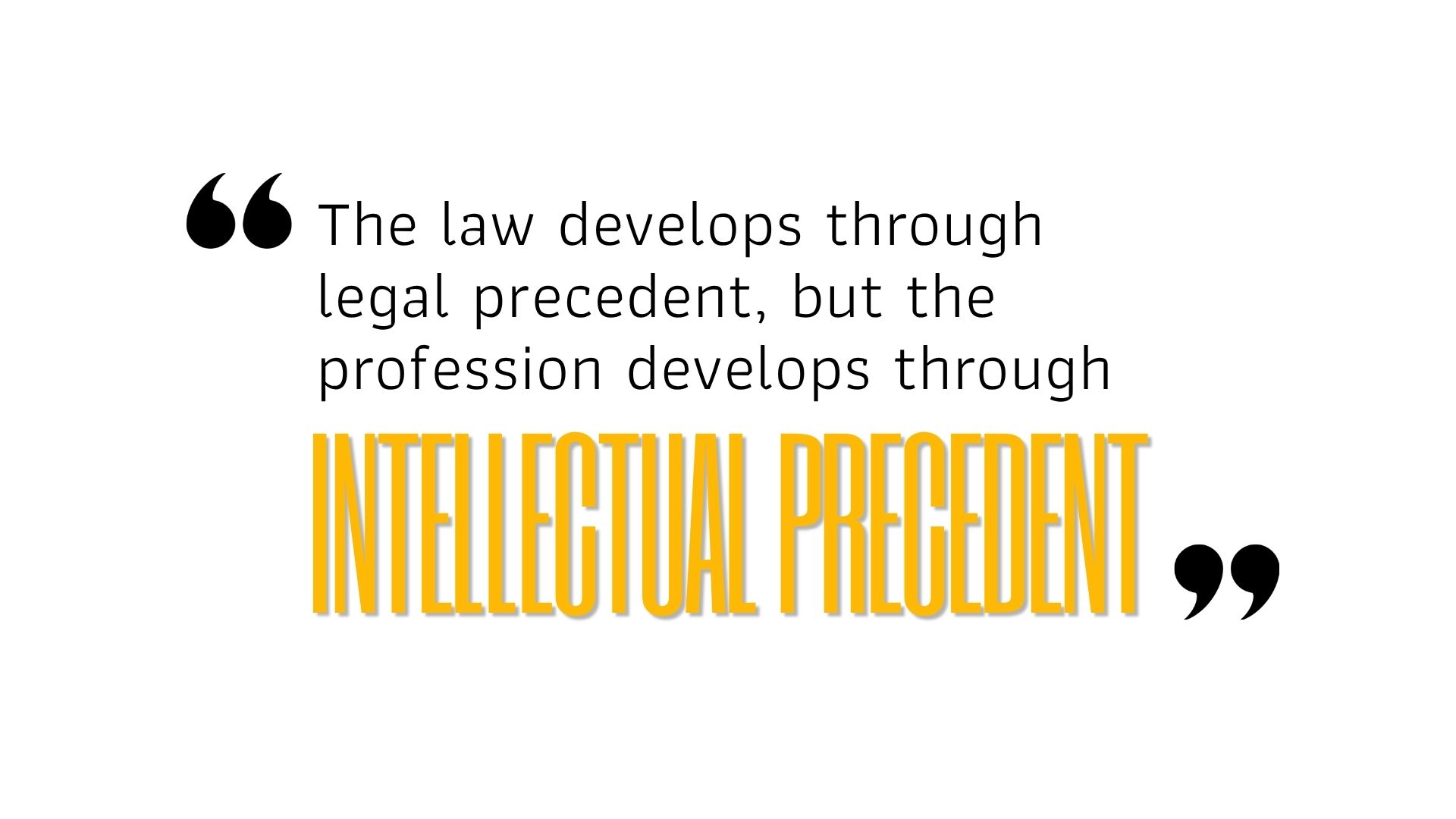
The law develops through legal precedent, but the profession develops through intellectual precedent.
Legal precedents determine how future disputes may be decided. Intellectual precedents shape how future lawyers learn to reason, persuade, advise, and exercise judgment.
The law records countless judgments, but the profession remembers remarkably few minds.
That distinction may reveal more about legal greatness than any list of reported cases ever could.
______________________
Continue the conversation
Join our WhatsApp Channel for insights on legal practice, professional reputation, strategic communications, leadership, client trust, and the future of the legal profession.
______________________
Also read: Does Every Legal Strategy Create Two Cases?
How Energy Companies Lose Control of Their Own Story