
– By Mayuri Singh and Nishant Saxena
Three developments involving battery storage appeared within days of each other last week.
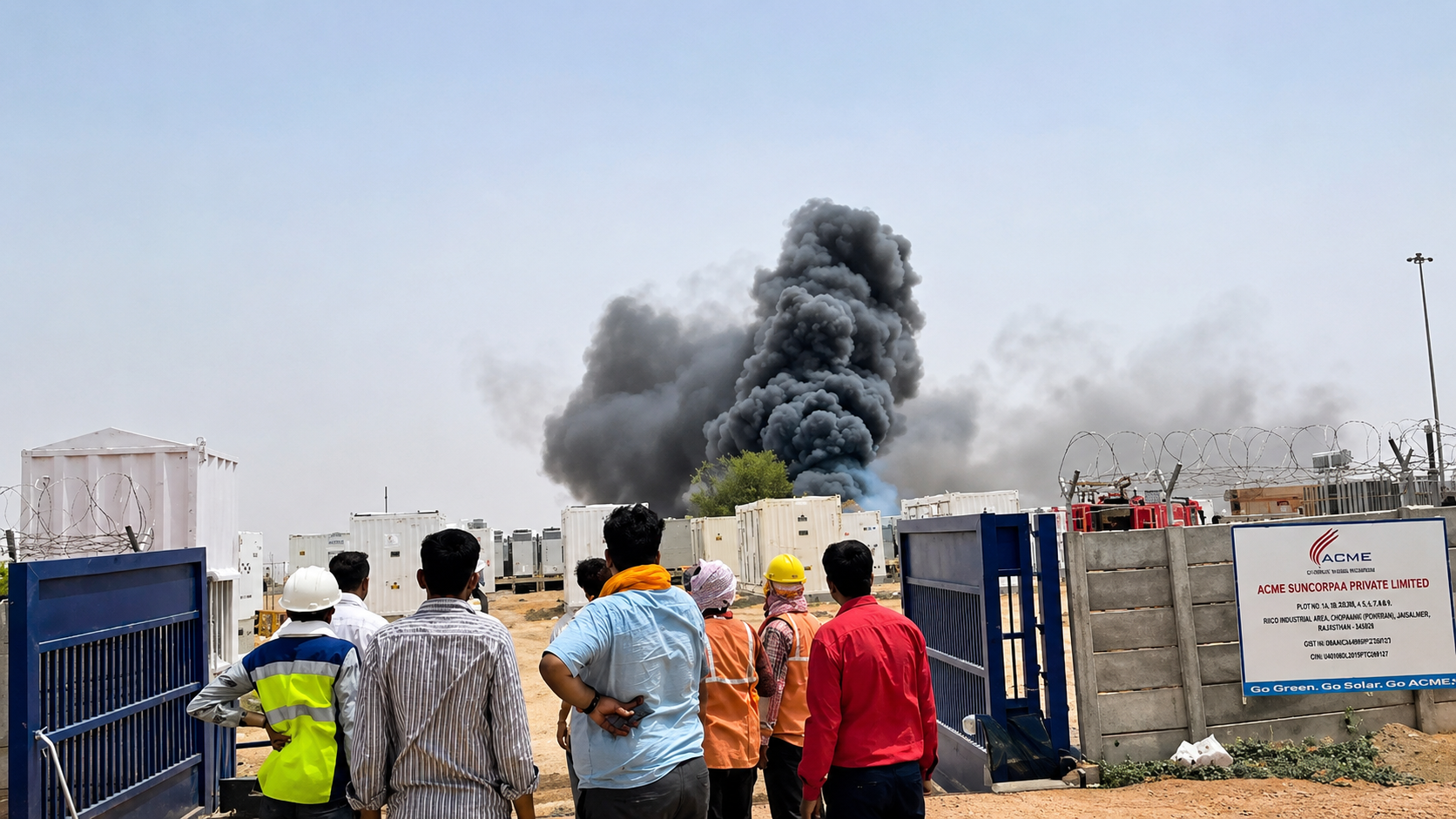
The Ministry of Heavy Industries invited bids for the remaining 10 GWh under India’s 50 GWh Advanced Chemistry Cell (ACC) Production Linked Incentive (PLI) scheme, reserving it for grid-scale stationary storage. The government’s PAIMANA platform then projected India’s energy storage requirement rising from 87 GWh in 2027-28 to 888 GWh by 2035-36, supported by around 80 GW of Battery Energy Storage Systems (BESS) and 94 GW of Pumped Storage Projects (PSPs). Around the same time, ACME Solar clarified that a fire at one of its battery energy storage facilities had originated in four Power Conversion System (PCS) units following an IGBT-related short circuit, while the battery containers remained unaffected.
On the surface, these developments concern industrial policy, electricity planning and operational reliability. Taken together, they suggest battery storage is entering a stage in which it must be understood not only as an engineering solution, but as infrastructure that institutions are beginning to plan around.
Institutions Start Planning
For much of the past decade, battery storage has been answering the questions that define every emerging technology. Could it support a more renewable grid? Would costs fall fast enough? Could supply chains mature? Would projects perform reliably beyond pilots?
The policy signals now suggest that the answer is no longer theoretical. The ACC PLI allocation is not merely a manufacturing incentive. It reflects an expectation that grid-scale storage will become a durable part of India’s electricity system. Incentives of this scale are usually designed around anticipated demand, not speculative possibility.
The PAIMANA projections reinforce the same shift from another angle. A projected storage requirement of 888 GWh by 2035-36 means planners are no longer treating storage as an optional add-on. They are beginning to assume that it will perform reliably at scale, across years of investment, regulation and operation.
That is how technologies begin to move from promise to infrastructure.
When Incidents Travel
That broader transition also explains why an operational incident at ACME Solar’s battery energy storage facility in Pokhran attracted attention well beyond the project itself.
Initial reports and social media discussions suggested that multiple battery containers had caught fire. ACME later clarified that the incident was confined to four PCS units following an IGBT-related short circuit, while the battery containers remained unaffected. For engineers, that distinction is significant because a PCS fault and a battery thermal event involve very different failure mechanisms.
A PCS fault is not the same as a battery fire, and the difference matters. The PCS is the interface that manages how electricity flows between the grid and the battery; when it fails, the problem usually lies on the conversion or control side of the system, not inside the battery cells themselves. A battery fire, by contrast, raises questions about thermal runaway, containment and propagation risk. That is why precision matters: the technical cause determines both the risk profile and the public interpretation of the event.
Outside the engineering community, the same incident prompted different questions. Regulators asked whether existing standards remain adequate. Lenders and insurers reassessed equipment risk. Developers looked for operational lessons. Journalists asked what the incident meant for battery storage, while many members of the public asked a simpler question – is this technology safe?
The facts may have been the same, but the lens through which they were read was not. Engineers look for root cause. Regulators look for standards. Investors look for risk. Communities look for reassurance that one fault does not imply a broader systemic problem.
From Evidence To Trust
Explaining the engineering is only part of the task. As technologies move from engineering acceptance to institutional acceptance, they also have to pass through interpretation.
Different stakeholders need different context to make informed decisions. Without that context, technical evidence can quickly be reduced to simplified narratives, and those narratives often shape public understanding more powerfully than the engineering itself.
The electricity sector has travelled this road before. Wind power once carried the burden of proving that variable generation could coexist with reliable electricity systems. Competitive electricity markets spent years being judged through every price spike, settlement issue and operational challenge. Individual projects were often expected to justify the technology itself.
That burden faded with experience because the institutions around those technologies became more capable of judging isolated events in context. Regulations evolved, operating records grew, and investors became more familiar with the risks they were financing. As evidence accumulated, one incident stopped defining the entire technology.
Battery storage is approaching the same point. Industrial policy is expanding manufacturing capacity. Grid planners are incorporating storage into long-term system design. Developers are building operational experience that will inform future projects. Together, these developments are creating the institutional experience that every infrastructure technology eventually requires.
As deployment grows, operational incidents will inevitably occur. The measure of maturity will not be the absence of those incidents. It will be the ability of institutions to understand them, respond proportionately and distinguish isolated equipment failures from systemic concerns.
That is where strategic communication becomes part of infrastructure development rather than an activity that follows it. Its role is not to soften difficult events or manufacture confidence. It is to ensure that technical evidence reaches policymakers, markets and the public with enough context to be understood in proportion. Without that, isolated incidents can shape public narratives more powerfully than years of reliable operation.
Parting Thoughts
India is no longer deciding whether battery storage belongs in the electricity system. The more demanding task now is to complete the second journey, from engineering proof to institutional acceptance, well.
Every mature infrastructure technology eventually earns one privilege: it is judged one project at a time. Transmission lines earned that privilege. Renewable energy did too. Electricity markets did too. Battery storage is still earning it.
At what point do you think an emerging technology stops proving that it works and starts proving that society can depend on it?
_________________________
Want more insights like this?
Click here to join our WhatsApp Channel for strategic communications insights, leadership perspectives, industry observations, in-depth analysis, and practical communications tips.
________________________
Also read: The Questions the SHANTI Act Leaves Open
How Energy Companies Lose Control of Their Own Story