
When does an advocate stop being an advocate? For generations, the answer appeared self-evident. The judge rose, the proceedings ended, files were closed, and the black robe came off.
Advocacy belonged to the courtroom, while the life outside it belonged to the individual. The robe marked not only a professional role, but also its boundaries.
Today, that answer no longer feels complete. The ethical duties of advocates have not fundamentally changed. The more significant change is that the legal profession is no longer encountered only in the places where law is practised. It is encountered almost everywhere else.
The Bar Council of India’s recent Circular on digital ethics and social media shows this shift. It may appear to regulate lawyers’ conduct on social media and other digital platforms, but the Circular also acknowledges that public confidence in the legal profession is not just shaped inside courtrooms or chambers, but also shaped wherever lawyers become visible.
The Circular does not create this reality. It responds to it, and that makes it more than guidance on professional conduct. It is an institutional recognition that the boundaries of professional identity have slowly expanded.
The more interesting question, therefore, is no longer whether advocates should behave professionally online; it is whether professional identity has ceased to be situational.
When Trust Became Continuous
The legal profession has always depended upon public confidence. What has changed is the way that confidence is formed.
For much of legal history, society encountered lawyers in relatively defined institutional settings. Clients met advocates in chambers. Judges observed them in court. Colleagues interacted within the profession itself. Public trust developed through those limited encounters because there were relatively few others from which to draw conclusions.
Professional identity was, in effect, situational. That distinction has gradually faded.
Today, a lawyer may first be encountered through a podcast, a conference address, a media interview, a LinkedIn article or even an AI-generated summary before any actual professional interaction takes place. Technology has expanded the number of occasions on which society encounters lawyers. More importantly, it has expanded the ways in which the profession itself is interpreted.
Technology did not redefine the legal profession; it redefined its visibility. This distinction is significant because people rarely assess professionals one interaction at a time.
They accumulate observations, connect them and gradually form a stable impression. Every public appearance, every article, every interview and every professional interaction becomes another piece of a larger narrative about the lawyer and, increasingly, about the institution that lawyer represents.
Trust is no longer built through isolated moments. It is built through accumulated interpretation.
The Continuous Robe
Perhaps this is the profession’s most significant transition.
For generations, the robe symbolised the beginning of advocacy because it also marked the beginning of professional visibility. When the day’s work ended, both appeared to recede together.
Today, the symbolism has changed. The robe still marks where advocacy is formally exercised. It no longer marks where the profession is encountered.
That does not mean lawyers are expected to perform their professional role every moment of the day. It means society no longer separates professional identity as neatly as lawyers once could. The public forms judgments by connecting visible moments into a coherent understanding of character, judgment and credibility.
Where earlier generations inherited a profession that was visible principally inside legal institutions, today’s lawyers practise within a profession that is interpreted continuously.
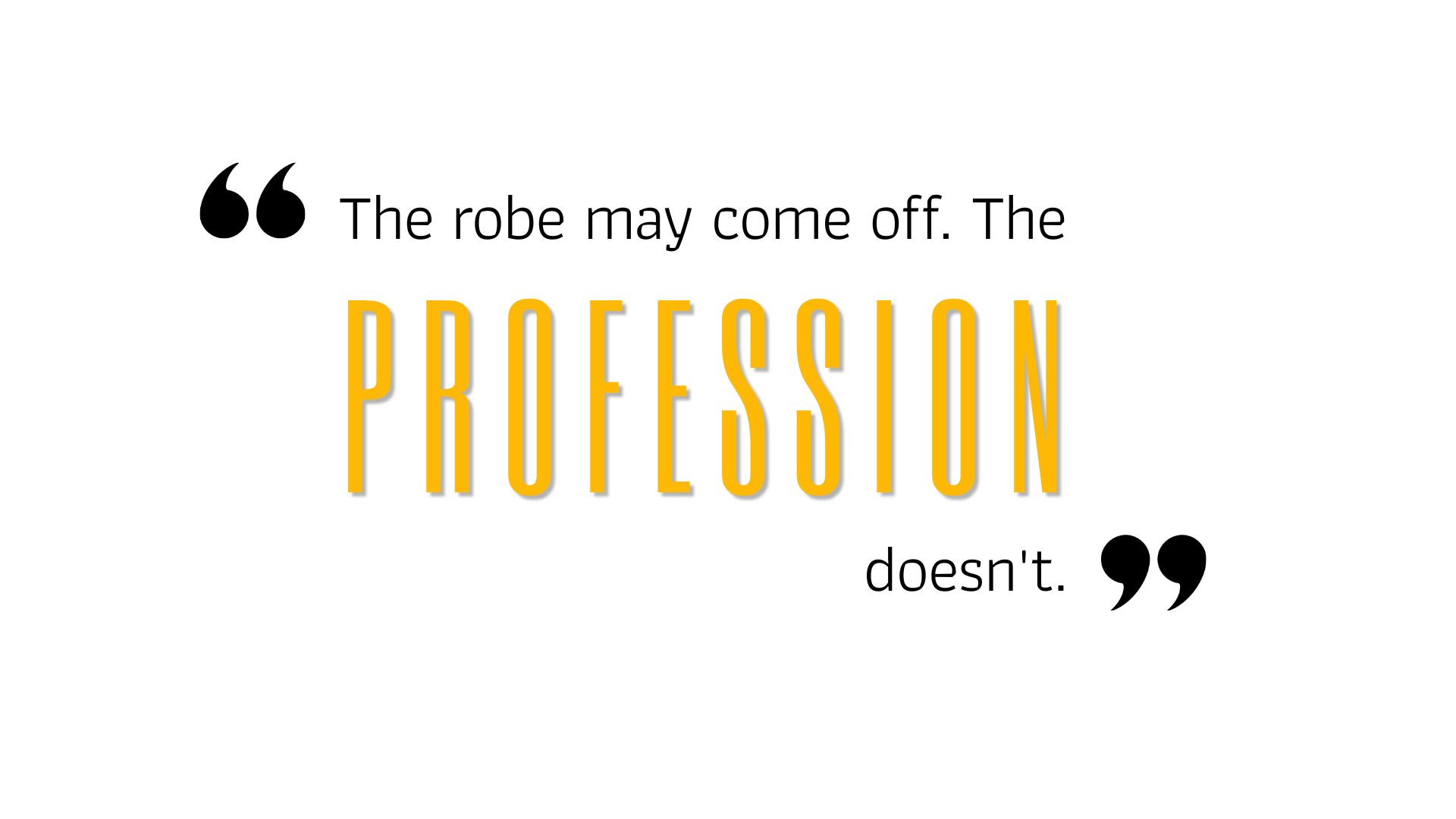
The robe may still come off at the end of the day. The professional identity it represents no longer does.
Leadership Beyond the Courtroom
If trust has become continuous, leadership cannot remain situational.
For much of the profession’s history, leadership was demonstrated through advocacy, scholarship and mentorship within relatively defined professional spaces. Those continue to matter. They are no longer the only places where leadership is interpreted.
Today, every visible interaction contributes to how the profession is understood. And this changes the nature of institutional leadership.
Managing Partners often think about succession in terms of clients, practice areas, revenue and partnerships. But every leadership transition also passes on something less tangible and ultimately more enduring: the culture of professional judgment.
Young lawyers rarely learn that culture from induction programmes or policy manuals. They learn it by watching. They observe how senior lawyers disagree without becoming disagreeable. How difficult clients are counselled. How colleagues are treated under pressure. How ethical dilemmas are navigated when the law leaves room for discretion. Even before values are articulated, they are demonstrated.
Professional culture is inherited through observation before it is reinforced through instruction. That same principle now extends beyond the walls of the firm.
Clients, recruits, regulators and the wider public increasingly form impressions in exactly the same way. They accumulate visible signals and draw broader conclusions about the lawyer, the firm and, by extension, the profession itself.
This is why communication can no longer be treated as something separate from legal practice.
Every article, interview, public address or digital interaction may appear to be an individual act of expression. Together, however, they shape how professional judgment, credibility and trust are understood. Communication has become one of the ways in which the profession itself is interpreted.
The Bar Council of India’s Circular reflects precisely this institutional reality. It recognises that confidence in the legal profession is no longer influenced only by advocacy inside the courtroom. It is equally shaped by the conduct through which society encounters lawyers outside it.
In that sense, the Circular is less about social media than stewardship. It reminds the profession that while lawyers speak as individuals, they are usually understood as representatives of something much larger.
The Profession That Never Leaves You
We began with a simple question: When does an advocate stop being an advocate?
Perhaps the question belongs to another era. It assumes that the robe defines the limits of professional identity, and that public trust is earned only where law is formally practised.
Neither assumption fully reflects the profession today. The courtroom remains the place where advocacy is exercised. It is no longer the only place where the profession is encountered.
That is the deeper significance of the Bar Council’s Circular. Beyond its immediate guidance, it also acknowledges that trust in the legal profession is now built across a far wider landscape of public interaction than ever before.
Every visible act contributes, in some measure, to the reputation of an individual lawyer and to the legitimacy of the institution that lawyer represents.
The robe still marks the beginning of advocacy. It no longer marks the end of the profession.
Wherever society encounters a lawyer, it also encounters the legal profession.
Perhaps that is what the Bar Council’s Circular silently recognises.
______________________
Continue the conversation
Join our WhatsApp Channel for insights on legal practice, professional reputation, strategic communications, leadership, client trust, and the future of the legal profession.
______________________
Also read: Who Owns the Reputation of the Legal Profession?
Why Good Energy Decisions Still Lose Public Trust