
Every generation inherits the profession. Every generation decides what the next one receives.
Conversations about the reputation of the legal profession usually begin with an unspoken assumption that the profession belongs to those who practise it. Perhaps it never did.
Reputation suggests ownership. It implies that lawyers build it over the course of their careers, protect it through their conduct and eventually leave it behind as part of their professional legacy. But no advocate begins practice with a reputation of their own. Before drafting a pleading, arguing a matter or earning a client’s confidence, every newly enrolled lawyer steps into a profession that society has already chosen to trust.
That confidence was built over generations by lawyers they will never meet. One day, it will pass to lawyers they will never know.
I would like to consider the legal profession as an inherited institution. No generation owns it. Each receives it for a time, shapes it through thousands of visible and invisible decisions, and eventually leaves it to the next.
Once that distinction is recognised, reputation begins to look less important than legitimacy. Reputation belongs to individuals, but legitimacy belongs to institutions. A lawyer may spend a lifetime earning professional credibility, but the authority to advise clients, appear before courts and participate in the administration of justice depends on society’s continuing belief that the institution itself deserves its confidence.
This perspective offers a different way of reading the Bar Council of India’s recent Circular on digital ethics and social media. Much of the discussion has centred on regulating online conduct. The Circular’s emphasis on professional dignity, confidentiality, public confidence and the advocate’s role as an officer of the court is, at its heart, an effort to preserve the legitimacy of the institution rather than merely regulate the behaviour of individuals.
The conversation, therefore, is not really about social media; it is about preserving the conditions that allow the legal profession to remain worthy of public trust.
We Inherit More Than a Licence to Practise
Every profession depends upon technical competence. The legal profession depends upon something even more valuable i.e. society’s willingness to trust those who exercise that competence.
Lawyers are entrusted with liberty, constitutional rights, commercial decisions, family relationships and deeply private confidences. That trust cannot be created by any individual lawyer. It accumulates over generations through the conduct of countless professionals, many of whom will never know those who eventually inherit the benefit of their work.
Professional reputation is earned, but institutional legitimacy is inherited.
That distinction changes the meaning of professional responsibility. Lawyers are not merely responsible for protecting their own standing. They become temporary custodians of an institution whose credibility they neither created nor can entirely control.
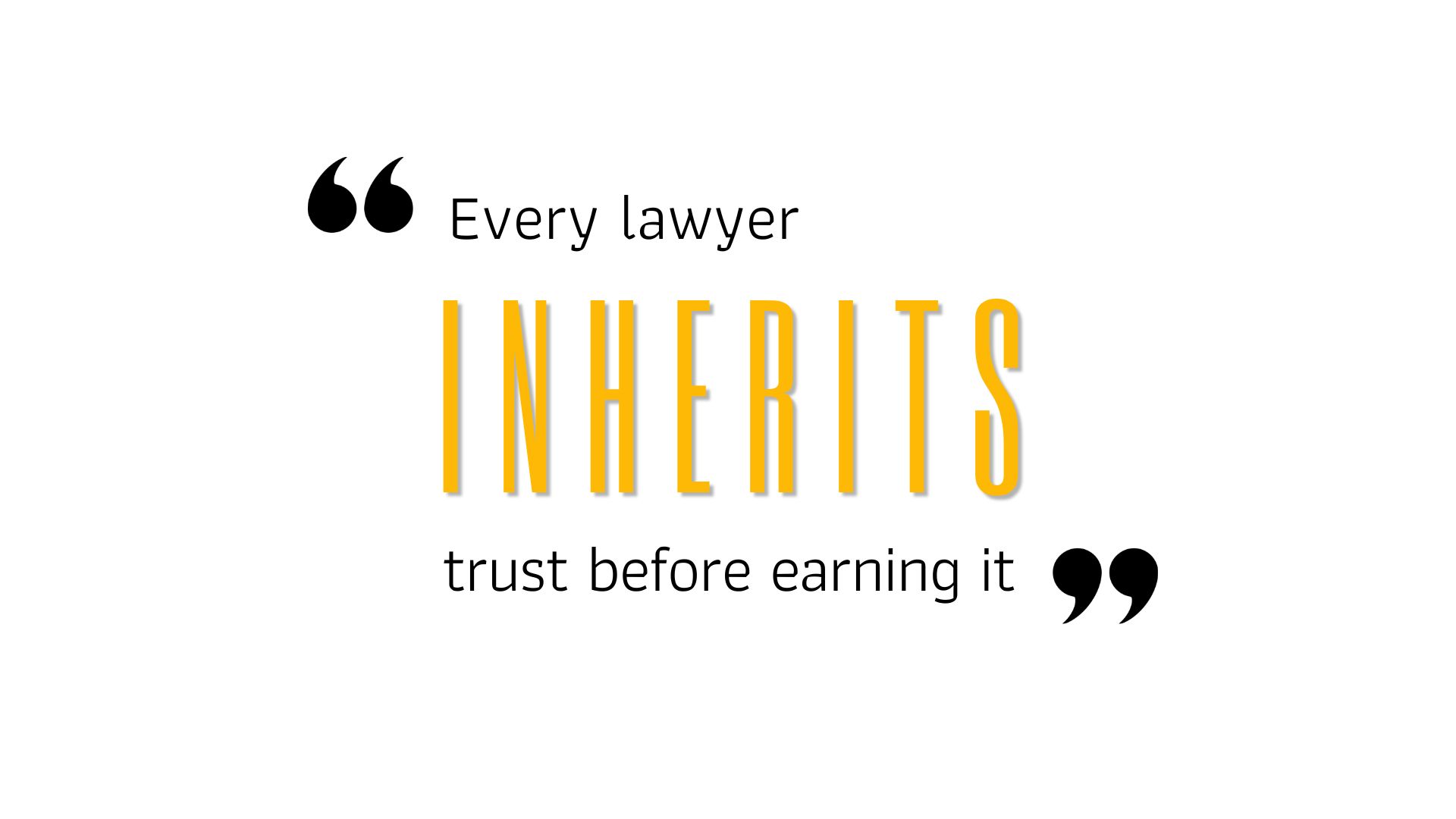
Every lawyer, in other words, inherits trust before earning it.
Society Understands Institutions Through the People It Sees
Most people never encounter institutions in the abstract. They encounter people and, through those encounters, form opinions about the institutions those people represent.
The legal profession is no exception.
Few members of the public read judgments or study professional ethics before deciding whether lawyers deserve their confidence. Their impressions emerge from everyday encounters like a consultation, a courtroom exchange, a television interview, a LinkedIn post or a legal explainer that appears on a phone screen. Increasingly, first impressions are shaped by AI-generated summaries, short-form videos and digital conversations that unfold far from the courtroom.
No single interaction defines the profession. Together, however, they shape its public meaning.
When people say, “From what I have seen, lawyers…”, they believe they are describing individuals. More often than not, they are judging an institution.
That is why conduct matters beyond ethics alone. Every public interaction becomes part of the evidence through which society interprets the legal profession. Facts and legal outcomes remain important, but public trust is shaped equally by what those actions come to signify.
Institutions, after all, are judged not only by what they do, but also by what others believe those actions mean.
Leadership in an Inherited Profession
If legitimacy is inherited, professional responsibility extends beyond ethics. It becomes a question of leadership.
Institutions endure because each generation slowly passes its standards to the next. Every profession develops unwritten norms on how difficult clients are advised, how younger colleagues are mentored, how disagreement is expressed, and where ethical lines are drawn when rules leave room for judgment.
Law is no different.
Much of what young lawyers learn about professionalism comes not from statutes or codes of conduct, but from watching experienced lawyers at work. Culture is transmitted long before it is articulated. Long before leadership changes hands, future leaders have already absorbed an idea of what the profession stands for.
That is why succession is about far more than clients, partnerships or practice areas. Every generation also inherits a professional culture and, with it, a responsibility to strengthen or diminish the institution’s legitimacy.
The digital age has made that responsibility more visible.
The profession has not lost its authority. It has, however, lost its ability to determine how that authority is interpreted. Today, public understanding of law is shaped not only by courts and Bar associations, but also by algorithms, AI-generated summaries, short-form videos and conversations that unfold across digital platforms.
The BCI’s Circular should be understood in that context. Its significance extends well beyond social media. It acknowledges that public confidence is now formed wherever the profession becomes visible, making institutional legitimacy a matter not only of legal conduct but also of public interpretation.
This presents a challenge that reaches beyond compliance.
Lawyers have always understood that justice must be done and must also be seen to be done. The same principle increasingly applies to the profession itself. Professional standards must continue to exist, but they must also be consistently reflected in the way the institution is encountered and understood by society. When that connection weakens, public trust begins to erode long before professional standards themselves do.
Leadership, therefore, is no longer confined to guiding clients or building successful practices. It also involves shaping the institutional culture that others inherit and protecting the public confidence on which the profession ultimately depends.
That responsibility belongs not only to Bar Councils or senior leaders. It belongs, in different ways, to every lawyer whose conduct contributes to the profession’s collective identity.
The Profession Belongs to the Next Generation
That brings us back to the question with which we began. Who owns the reputation of the legal profession?
Perhaps no one does.
Reputation may belong to individuals. Legitimacy belongs to the institution, and institutions are never the possession of a single generation. They are inherited, held in trust for a time and then passed on.
The law entrusts lawyers with the rights, freedoms and interests of others. The profession entrusts them with something equally significant. Its legitimacy.
Every lawyer receives that inheritance.
The question each generation answers is not whether it protected its own reputation.
It is whether the profession it leaves behind deserves at least as much confidence as the one it inherited.
______________________
Continue the conversation
Join our WhatsApp Channel for insights on legal practice, professional reputation, strategic communications, leadership, client trust, and the future of the legal profession.
______________________
Also read: How Does the Legal Profession Decide Whom It Remembers?
The Second Test of Battery Storage